

Don’t Let Your Radiator Kill Your Engine: The Coolant Mistake Most Drivers Make
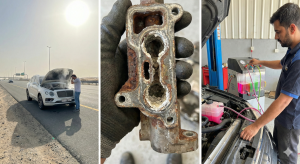
It is a sight all too common on the shoulder of Sheikh Zayed Road during the peak of July: a luxury vehicle with its hood popped open, steam billowing into the humid air, and a frustrated driver stranded in 48°C heat. For many UAE residents, this scenario is a nightmare, yet it is often the result of a seemingly harmless habit practiced months prior. The culprit isn’t always a mechanical failure or a manufacturing defect; often, it is the liquid pouring out of the radiator cap. In a region where ambient road temperatures can exceed 60°C, the fluid you choose to put in your cooling system is the single most critical factor determining whether you reach your destination or wait for a recovery truck.
The temptation to top up a reservoir with water from a garden hose or a plastic bottle is understandable. It looks like water, it flows like water, and it seems to cool things down. However, modern automotive engineering operates on precise chemical and thermal tolerances that plain water simply cannot support. When you introduce tap water into a high-performance cooling ecosystem, you are essentially introducing a corrosive, low-boiling-point contaminant that begins to eat your engine from the inside out.
The consequences of this mistake are rarely immediate, which makes them dangerous. It begins silently with internal oxidation and pressure buildup, eventually leading to catastrophic failures that require extensive and expensive engine Repair services. By understanding the physics of heat transfer and the chemistry of corrosion, you can avoid becoming another statistic on the side of the highway. This guide explores the technical reality of why “water is water” is a myth that destroys engines, and what you need to do to protect your vehicle today.
The Physics of Boiling: Why Water Fails in the Desert
To understand why tap water is insufficient for the UAE climate, we must look at the thermodynamics of a combustion engine. Internal combustion engines generate immense heat—far more than is converted into motion. The cooling system’s job is to absorb this excess heat and dissipate it via the radiator.
Pure water boils at 100°C (212°F) at sea level. However, modern engines are designed to operate efficiently at temperatures very close to, or sometimes exceeding, this limit. In the stop-and-go traffic of Sharjah or Dubai, coolant temperatures can easily spike. If you are running straight water, it will flash into steam at 100°C. Steam is a gas, and unlike liquid, it cannot effectively absorb or transfer heat from the engine block components. This phenomenon, known as “vapor lock” in the cooling passages, creates localized hot spots that warp cylinder heads and blow gaskets.
The Pressure Advantage
Proper engine coolant (a mix of ethylene glycol and distilled water) has a higher boiling point than pure water—typically around 106°C at atmospheric pressure. However, the magic happens when this is combined with your radiator cap. The cooling system is a pressurized environment. Physics dictates that as pressure increases, the boiling point of a liquid rises.
A standard 15 PSI (pound-force per square inch) radiator cap raises the boiling point of a 50/50 coolant mixture to approximately 129°C (268°F). This 29-degree buffer is essential in the UAE. It ensures that even if your engine gets hotter than usual while climbing Jebel Jais or sitting in traffic on Hessa Street, the fluid remains a liquid, continuing to cool the engine. Straight water, lacking the chemical properties of glycol, provides a significantly smaller safety margin, putting your engine at immediate risk of boil-over.
The Invisible Enemy: Galvanic Corrosion and Electrolysis
While boiling is an immediate threat, corrosion is the long-term killer. This is where the distinction between “tap water” and “coolant” becomes a matter of chemistry. Tap water is loaded with dissolved minerals—calcium, magnesium, iron, and chlorine.
The Battery Effect
Your engine is built from various metals: aluminum cylinder heads, cast iron blocks, copper brass heater cores, and aluminum radiators. When you fill this multi-metal system with mineral-rich tap water, you create a chemical battery. The water acts as an electrolyte, facilitating the flow of ions between the dissimilar metals. This process is called galvanic corrosion.
In this electrochemical battle, the “anodic” metals (usually aluminum) sacrifice themselves to the “cathodic” metals. The result? Your water pump impeller dissolves, your cylinder head develops pitting, and your radiator core rots from the inside. Proper coolant contains specific corrosion inhibitors (additives) that coat these metal surfaces, electrically insulating them and preventing this destructive ion exchange.
Scale Buildup: The Efficiency Killer
Have you ever looked inside a kitchen kettle and seen the white, chalky flakes on the bottom? That is calcium carbonate scale. Now, imagine that layer forming inside the delicate, narrow tubes of your car’s radiator.
Scale acts as a thermal insulator. It prevents heat from moving from the coolant into the metal fins of the radiator to be carried away by the air. The statistics on this are alarming:
- A scale layer of just 1/32 of an inch can reduce heat transfer efficiency by 2–7%.
- A layer of 1/16 of an inch can reduce heat transfer by over 12%.
In the UAE, where your cooling system needs 100% of its capacity to handle the ambient heat, a 12% loss in efficiency is catastrophic. It means your engine runs hotter, oil degrades faster, and components fail sooner. Tap water is the primary source of this scale. Distilled water, used in proper coolant mixes, is free of these minerals, ensuring your radiator remains clean and efficient.
Cavitation: When Bubbles Attack
There is a violent phenomenon occurring inside your water pump called cavitation. As the water pump impeller spins at high speeds, it creates zones of low pressure. If the fluid’s vapor pressure is too low (like plain water), tiny bubbles form in these low-pressure zones. When these bubbles move to a high-pressure zone a split second later, they collapse or “implode” with incredible force.
These implosions send microscopic shockwaves into the metal of the water pump impeller. Over time, this blasts tiny bits of metal off the surface, creating a pitted, moon-like terrain. Eventually, the impeller blades can be eaten away entirely, causing the pump to fail and coolant circulation to stop.
High-quality coolants contain anti-foaming agents and are chemically formulated to resist vapor formation, significantly reducing cavitation damage. Plain water offers zero protection against this physical erosion.
The “Rainbow” Mistake: Mixing Coolant Colors
If you decide to switch from water to coolant, or top up your existing system, you must be vigilant about color. The automotive market offers Green, Pink, Orange, Blue, and Yellow coolants. These are not just dyes; they represent different chemical technologies (Inorganic Acid Technology – IAT, Organic Acid Technology – OAT, and Hybrid OAT).
Warning: Never mix different coolant colors.
Mixing a Green IAT coolant (high in silicates) with a Pink OAT coolant can trigger a chemical reaction that causes the additives to “drop out” of the solution. This creates a thick, gel-like sludge often described as brown mud. This sludge clogs radiator passages and heater cores, effectively stopping coolant flow. Once this happens, a simple drain and refill is not enough; the system often requires aggressive chemical flushing or component replacement.
For many modern vehicles in the GCC, a G12++ specification is recommended, but you should always consult your owner’s manual or a specialist at Smart Garage to ensure compatibility.
Actionable Advice: The 5-Minute Diagnostics Check
You do not need to be a mechanic to assess the health of your cooling system. Here is a simple check you can perform this weekend (ensure the engine is cold):
- The Color Test: Open the hood and locate the translucent coolant overflow reservoir. The fluid inside should be vibrant and clear (Pink, Green, or Blue).
- The “Rust” Warning: If the fluid looks like brown, rusty water, or has floating particles, corrosion is already advanced. This brown color is literally the rust from your engine block floating in the water.
- The Hose Squeeze: Squeeze the large rubber radiator hoses. They should feel firm but pliable. If they feel “crunchy” when squeezed, it indicates internal rust has embedded into the rubber. If they feel overly soft or spongy, oil may be contaminating the system.
Actionable Tip: “Check your coolant reservoir color. If it looks like rusty water, you need a flush immediately. Leaving it in will accelerate the corrosion of your water pump and head gasket.”
The Solution: Flush vs. Drain
If you find tap water or old coolant in your system, simply opening the drain plug (petcock) at the bottom of the radiator is not enough. A “gravity drain” only removes about 50-60% of the fluid; the rest remains trapped in the engine block and heater core, contaminating the new fluid you pour in.
To truly protect your asset, you need a professional coolant flush. This process uses a machine to pump new fluid through the system under pressure, forcing out the old contaminants, scale, and sludge from every corner of the engine block. It ensures a 100% fluid exchange and restores the cooling system’s efficiency.
Conclusion: Prevention is Cheaper than Repair
In the harsh environment of the UAE, your car’s cooling system is its lifeline. The cost of gallons of distilled water and high-quality coolant is negligible compared to the cost of a warped cylinder head or a seized engine. Do not gamble with tap water. It is a slow poison that degrades your vehicle’s performance and reliability with every kilometer driven.
Whether you need a chemical flush to remove scale, a diagnostic check for leaks, or advice on the correct G-standard coolant for your car, professional intervention is key. Protecting your engine today ensures you won’t be the one waiting for a tow truck tomorrow.
Summary Takeaways
- The Hook: Overheating is the fastest way to destroy an engine in the UAE.
- The Problem: Tap water boils at 100°C, causes 12% heat transfer loss via scale, and eats metal via galvanic corrosion.
- The Fix: Use a 50/50 mix of proper coolant and distilled water to raise the boiling point to 129°C and prevent rust.
- Immediate Action: Inspect your reservoir. If it’s brown, book a flush at Smart Garage immediately.