The automotive market in March 2026 is already heating up. Dealerships are buzzing, new advertisements are flooding your social media feeds, and that nagging voice in your head keeps whispering, “Just buy the car now.” But if you can exercise a little patience just a few weeks of patience you might find yourself behind the wheel of a much better vehicle for significantly less money.
The reason? The 2026 Beijing International Auto Show is right around the corner. Kicking off in April, this isn’t just another industry gathering where executives give speeches and journalists snap photos of concept cars. It’s a market-shaping event that will send shockwaves through dealerships and showrooms across the country and potentially put thousands of dollars back in your pocket .
Here is why waiting until after the Beijing Auto Show could be the smartest financial decision you make this year.
The Avalanche of New Metal: What’s Coming in April
Let’s start with the sheer volume of what’s about to hit the market. The Beijing Auto Show isn’t a trickle of new models; it’s a deluge. Industry tracking suggests that over 20重磅新车 (heavyweight new cars) will break cover during the event, and this isn’t just a refresh of existing models we’re talking about ground-up reinventions, new brands, and technology that makes current showroom inventory look suddenly, uncomfortably dated .
Consider what’s heading for the spotlight. BMW is pulling the wraps off the long-wheelbase Neue Klasse iX3, an electric Sports Activity Vehicle built on an entirely new architecture. We’re not talking about a minor facelift here. This car features BMW’s “Heart of Joy” central control unit that integrates powertrain, braking, and steering through software, a panoramic iDrive system, and an 800-volt architecture enabling a CLTC range of over 900 kilometers . If you buy an electric BMW in March, you’re buying yesterday’s technology. Wait for April, and you’re looking at the future.
Then there’s the shockwave coming from the premium segment. Porsche is debuting the all-electric Cayenne. We’re talking about a Turbo Electric version packing 857 horsepower as standard, capable of hitting 1,156 horsepower in overboost, and rocketing from 0-100 km/h in a mind-bending 2.5 seconds. It charges from 10% to 80% in 16 minutes . If you’re in the market for a luxury SUV, the internal combustion version you buy in March will face immediate and severe depreciation the moment this electric beast is unveiled.
But the most disruptive force isn’t coming from Germany it’s coming from China’s own backyard. Xpeng is unveiling the GX, a six-seat flagship SUV that Chinese media is already calling a “budget Range Rover.” The styling deliberately echoes the Range Rover L460, but the price tag tells a different story. At approximately ¥400,000 (around NZ$96,000), it costs roughly one-third of the equivalent Range Rover in China. Under the skin, you’ll find steer-by-wire technology, rear-wheel steering, and the Kunpeng range-extender powertrain promising approximately 1,600 kilometers of range . This isn’t just competition; this is a market realignment happening in real-time.
The technology partnership between automakers and tech giants is also reaching full flower at this show. The new brand Yijing (奕境), a joint venture between Dongfeng and Huawei, will debut its first full-size SUV. We’re talking about a 5.2-meter vehicle with a nearly 3.2-meter wheelbase, six seats with aviation-grade chairs, and the full stack of Huawei technology:乾崑 (Qiankun) ADAS, HarmonyOS cockpit, and 乾崑 vehicle control . Similarly, the Qijing brand from GAC and Huawei is unveiling a猎装轿跑 (shooting brake coupe) that may feature industry-leading 500-line LiDAR and hardware architecture capable of L3 autonomous driving .
The message is clear: if you buy now, you’re buying the past. If you wait until April, you’re buying the future.
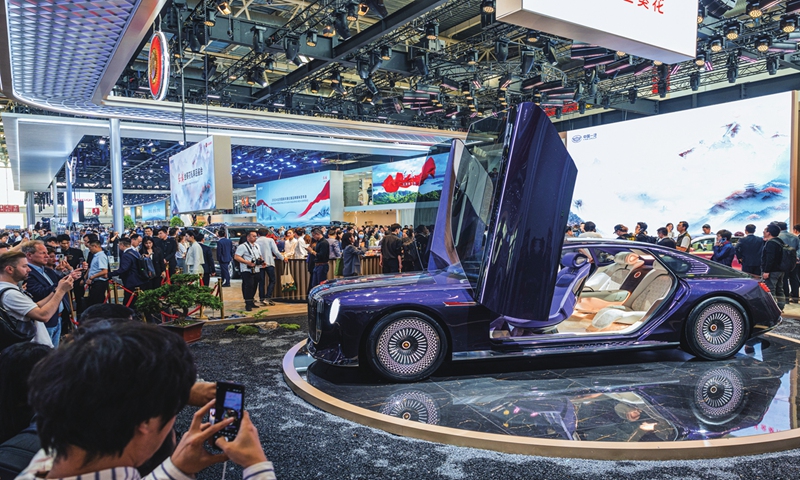
The Price Destruction Phenomenon: When New Launches Crash Used Prices
Here is where the potential savings come into play, and it’s important to understand the mechanics of how auto shows affect your wallet.
When a new generation of vehicles is unveiled, several things happen simultaneously. First, dealerships with current-generation inventory suddenly realize their stock is no longer “the new thing.” Those 2025 models sitting on the lot? They just became yesterday’s news. The pressure to move that inventory before the new models physically arrive creates a window of aggressive discounting that smart buyers can exploit .
Second, the pre-owned market takes an immediate hit. When the new BMW iX3 with its 900-kilometer range and “Heart of Joy” control unit becomes the talk of the internet, the value of a 2024 electric BMW drops—not slightly, but noticeably. The same applies to every vehicle in segments where new technology is being unveiled. If you’re considering a nearly new premium SUV, waiting until after the show could mean the difference between paying near-new prices and getting a genuine discount.
Third, and most significantly, the competitive pressure forces every manufacturer to sharpen their pencils. When Xpeng launches a vehicle that looks like a Range Rover but costs like a Toyota, every other automaker in that segment suddenly has a pricing problem. The response is almost always the same: incentives, rebates, low-rate financing, and dealer cash. You don’t have to buy the Xpeng to benefit from its existence. You just have to be in the market when every other brand is scrambling to compete with it .
The Technology Time Bomb: Why 7月1日 Matters
There’s another reason to pause before signing that March deal, and it involves a date that should be circled on every smart car buyer’s calendar: July 1, 2026.
This is the day new battery safety standards take effect in China. The upcoming national standard for power batteries requires that all electric vehicle batteries must not catch fire under various severe testing conditions. This represents a significant jump in safety requirements compared to current standards .
Here is why this matters for your April timing: vehicles unveiled at the Beijing Auto Show will likely be manufactured with these new standards in mind. Some may even beat the deadline, offering you a fundamentally safer vehicle for roughly the same money as current models with older battery technology. Others may be rushed to market before July 1 with existing battery packs, creating a clear distinction between “pre-standard” and “post-standard” vehicles that will affect resale value for years to come.
If you buy in March, you’re buying pre-standard technology with no clarity on how it compares to what’s coming. If you wait until April, you can make an informed decision—perhaps choosing a safer new model, or perhaps buying a discounted pre-standard vehicle with full knowledge of what you’re getting.
The Safety Net You Need Either Way
Now, before we get too deep into the financial case for waiting, let’s address something that applies whether you buy in March, April, or December. No matter when you purchase your vehicle, no matter how advanced the technology, no matter how many safety features the brochure promises things can still go wrong on the road.
This is where understanding your protection options becomes critical. When you’re driving your newly purchased vehicle whether it’s a discounted 2025 model or a cutting-edge 2026 unveil—you need to know what happens when the unexpected occurs. A dead battery on a cold morning, a flat tire on a remote road, or the sudden realization that you’ve locked your keys inside the car at a rest stop are not problems that respect whether you bought at the “right” time or the “wrong” time .
That’s why, before you finalize any purchase, you should verify what kind of car emergency service coverage comes with your vehicle and whether you need to supplement it. Many new cars include some form of roadside assistance, but the duration and scope vary dramatically. Some manufacturers offer one year; others offer longer. Some coverage follows the car; some follows the driver. Some includes generous towing distances; some leaves you paying per mile after a very short limit .
Understanding the distinction between basic roadside assistance and comprehensive coverage matters. Basic roadside assistance typically includes jump-starts, flat tire changes, fuel delivery, and lockout services. More comprehensive plans may include trip interruption benefits covering hotel stays and meals if you break down far from home—and higher towing mileage limits . The average cost of a single tow without coverage can range from $75 to over $200, and if you’re 50 miles from the nearest repair shop, those costs multiply quickly .
If your new car’s included coverage is minimal or short-term, or if you frequently drive in remote areas, purchasing an annual roadside assistance plan through your insurer or an auto club might be a wise investment. For an additional $25 to $75 per year, you eliminate the stress and financial uncertainty of unexpected breakdowns . Think of it as an insurance policy for your insurance policy—a small, predictable cost that prevents large, unpredictable expenses.
The “Impossible Triangle” and Your Buying Decision
Xpeng’s CEO recently claimed his company had solved the “impossible triangle” of automotive design: comfort, cargo space, and driving dynamics in one package at an aggressive price . But there’s another impossible triangle that every car buyer faces: new technology, low price, and peace of mind. You rarely get all three at once.
Waiting for the Beijing Auto Show gives you the best chance to balance this triangle in your favor. You’ll see the new technology before you commit. You’ll benefit from the price pressure on existing inventory. And by understanding your roadside assistance options—and ensuring you have proper coverage—you’ll have the peace of mind that no mechanical or electrical failure can truly strand you.
Consider the specific models that might fit your lifestyle. If you need a family hauler with three rows of seats, the Beijing show is bringing an embarrassment of riches. The Yijing full-size SUV with its six aviation-style seats, the Volkswagen ID. ERA nine-seat flagship, the零跑 D19 with six or seven seats and either extended-range or pure electric powertrains these vehicles are redefining what family transportation looks like . If you buy a three-row SUV in March, you’re buying before the category fundamentally resets in April.
If you’re a driving enthusiast, the smart精灵2 is returning to its roots as a classic two-door, two-seat city car, designed by Mercedes-Benz and built on modern EV architecture. The 智己 LS8 and 极氪 8X are pushing performance boundaries that didn’t exist last year . Why buy yesterday’s performance when tomorrow’s is about to be revealed?
Practical Steps: How to Play the Waiting Game
If you’re convinced that waiting until after the Beijing Auto Show makes sense, here is how to position yourself for maximum advantage.
First, do your research now. Identify the vehicles you’re interested in and understand their current pricing, incentives, and inventory levels. Bookmark the models you’re considering. When the show unveils their replacements or competitors, you’ll know immediately whether the new option is worth pursuing or whether the discounts on current inventory have become attractive.
Second, get pre-approved for financing. When the post-show discounts hit, you want to move quickly. Having your financing lined up in advance turns you into a cash buyer in the dealership’s eyes, giving you additional negotiating leverage.
Third, talk to dealers—but don’t commit. Let them know you’re aware of the upcoming show and that you’re watching how it affects pricing. Sometimes, dealers who are anxious to move March inventory will offer “show-proof” deals: pricing so aggressive that they guarantee to match any post-show discounts or let you cancel the deal. It never hurts to ask.
Fourth, and this bears repeating, verify your car emergency service coverage situation. Whether you buy before the show or after, whether you buy new or used, whether you buy electric or gasoline make sure you know who to call when things go wrong. Store the number in your phone, keep your membership card in your wallet, and understand what your plan covers before you need it .
The Verdict: To Wait or Not to Wait?
Here is the honest truth: if your current vehicle is unsafe, unreliable, or no longer meets your needs, and you’ve found a deal that works for your budget, buy the car. There is no financial optimization that outweighs the value of reliable transportation.
But if you have the flexibility to wait if your current car is running fine and you’re simply ready for an upgrade the calculus strongly favors patience. The 2026 Beijing Auto Show isn’t just another industry event. It’s a technological inflection point. It’s a pricing reset. It’s a moment when entire vehicle segments will be redefined.
The vehicles being unveiled in April will feature 800-volt architecture as standard, not as a premium option. They’ll offer charging speeds that add hundreds of kilometers of range in the time it takes to drink a coffee. They’ll pack LiDAR and AI chips that make today’s driver assistance systems look primitive. And they’ll do it at price points that force every competitor to respond .
By waiting until after the show, you position yourself at the intersection of multiple favorable trends: new technology you can evaluate, old inventory you can discount, and competitive pressure that benefits buyers. Whether you choose a cutting-edge 2026 model or a heavily discounted 2025 model, you’ll make that choice with full information rather than buying blind in March.
