
Why Car Batteries in the UAE Die Without Warning (And How to Predict It)
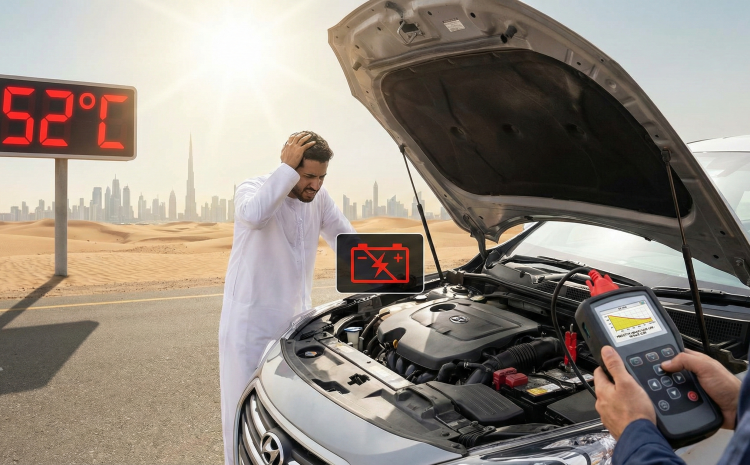
It is the sound every UAE driver dreads. You walk back to your car in the Mall of the Emirates parking lot, laden with groceries. You press the start button, and instead of the engine roaring to life, you hear a pathetic, rapid-fire “click-click-click.” Then, silence. The dashboard flickers and dies. Just two hours ago, the car started perfectly. What happened? Did you leave the lights on? Is the car cursed?
This phenomenon is known as “Summer Sudden Death,” and it is not a random occurrence. In the United Arab Emirates, where ambient temperatures regularly exceed 45°C, car batteries do not fade away gracefully like they do in cooler climates; they suffer catastrophic internal failure. For drivers, this unpredictability is a major source of anxiety. You aren’t just dealing with a flat battery; you are dealing with a chemical collapse that occurred months before the symptom appeared.
While many drivers view a dead battery as an inconvenience solved by a quick jump-start, the reality is often more complex. A battery damaged by the desert heat cannot simply be recharged. It often requires professional attention to assess whether the charging system the alternator and starter has also been compromised. At Smart Garage, we specialize in comprehensive car battery Repair services and advanced electrical diagnostics. Our goal is to move you from a reactive state of “waiting for a breakdown” to a proactive state of “predictive maintenance,” ensuring your vehicle handles the summer heat with reliability.
The Physics of Heat: Why 45°C is a Death Sentence
To understand why batteries die so suddenly here, we must look at the chemistry inside the black box. A standard car battery relies on a chemical reaction between lead plates and an electrolyte solution (sulfuric acid and water) to generate electricity. Temperature plays a massive role in how fast this reaction occurs.
According to the Arrhenius equation used in physical chemistry, the rate of chemical reaction doubles for every 10°C increase in temperature. While this extra power sounds good in theory, in practice, it means the battery is aging at warp speed. When the outside temperature is 45°C, the temperature under your car’s hood can easily exceed 80°C. In these conditions, the battery isn’t just working; it is cooking.
The Evaporation Effect
The primary killer is evaporation. The intense heat causes the water component of the electrolyte fluid to evaporate, even in “sealed” maintenance-free batteries. As water is lost, the acid becomes more concentrated. This concentrated acid is highly corrosive and begins to eat away at the internal lead grids that hold the active material. This process is silent and invisible, occurring slowly over the summer months.
“Grid Corrosion”: The Silent Assassin
The reason for the “Sudden Death” lies in the structural integrity of the battery’s internal grid. Think of the grid as the skeleton of the battery; it holds the paste that stores the energy and conducts the electricity to the terminals.
In cooler climates, batteries die because the paste wears out a gradual process that results in the car sounding “sluggish” when starting. This gives you a warning. In the UAE, the heat causes Grid Corrosion. The lead grid oxidizes and becomes brittle. Eventually, a piece of this corroded grid snaps off or disintegrates completely. This creates an internal open circuit. It is like cutting a wire inside the battery. One minute the connection is there; the next, it is physically broken. No amount of jump-starting will fix a broken internal grid. This is why the failure happens without warning.
The UAE vs. The World: A Lifespan Reality Check
Drivers who have moved to the UAE from Europe or North America are often shocked by how frequently they replace batteries. It is essential to adjust your expectations based on our climate reality.
- Average Battery Life in Europe: 4 to 5 years.
- Average Battery Life in the UAE: 18 to 24 months.
Research indicates that for every 10°F (approx. 5.5°C) rise in average temperature, a battery’s life is cut in half. If your battery is nearing the two-year mark, it is living on borrowed time. Treating a battery as a consumable item that needs replacement every two years, rather than a durable component, is the safest strategy for UAE car ownership.
The “Voltage” Myth: Why Your Dashboard Lies
One of the most dangerous misconceptions is that if your lights are bright and your radio works, your battery is fine. This is the difference between Volts and Amps.
A battery can show a healthy 12.6 Volts on a multimeter but have zero “Cold Cranking Amps” (CCA). Voltage is like the water pressure in a tank, while Amps are the volume of water available. A corroded battery can hold pressure (Voltage) but cannot deliver the volume (Amps) needed to turn over a heavy engine. This is why testing your battery with a simple voltmeter is useless for predicting failure.
The Solution: The “Load Test”
So, if the dashboard gauge doesn’t work and a multimeter is insufficient, how do you predict the death of a battery? The answer lies in Conductance Load Testing.
A professional load test simulates the immense stress of starting an engine. It sends a signal through the battery to measure the surface area of the lead plates. If the plates are corroded (sulfated), the tester will see the resistance.
The Smart Garage Prediction Protocol
We recommend a specific diagnostic approach for our customers:
- Frequency: Request a load test every time you get an oil change (every 10,000km).
- The Result: The test will give you a “Health Percentage.”
- 80-100%: Safe.
- 60-80%: Caution (Monitor closely).
- Below 50%: Replace immediately, even if it starts the car. It will fail within weeks.
Actionable Tip: “Ask us to perform a ‘Load Test’ on your battery during your next oil change. It predicts failure weeks before it happens.”
AGM vs. Flooded: Choosing the Right Weapon
Not all batteries are created equal. In the fight against UAE heat, technology matters. Most older cars use standard “Flooded” lead-acid batteries. However, modern cars with Start-Stop technology require AGM (Absorbent Glass Mat) batteries.
AGM batteries hold the electrolyte in glass mats like a sponge, rather than letting it slosh around freely. This design makes them significantly more resistant to vibration and, crucially, reduces water loss from evaporation. While they are more expensive, upgrading to a high-quality AGM battery can extend your service life in the desert climate significantly.
Actionable Steps to Extend Battery Life
While you cannot change the weather, you can change how your car interacts with it. Here are three steps to squeeze extra months out of your battery:
1. The “Clean Connection” Rule
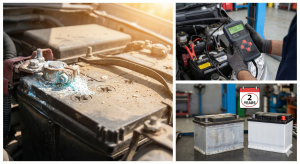
Heat accelerates corrosion on the outside of the battery too. That white or blue powder on your battery terminals is lead sulfate. It adds resistance, making the battery work harder to start the car.
DIY Fix: Clean the terminals with a mixture of baking soda and water using an old toothbrush. Ensure the connections are tight.
2. Park Like a Vampire
Direct sunlight on the hood raises engine bay temperatures drastically. Parking in the shade, or even using a car cover, can lower the battery’s operating temperature by 10-15 degrees. This small difference slows down the chemical degradation.
3. Drive Long to Recharge
Short trips are battery killers. Starting the car takes a huge amount of energy. If you only drive 10 minutes to the grocery store, the alternator doesn’t have enough time to replace that energy.
Tip: Once a week, take a drive of at least 20-30 minutes at highway speeds to ensure the battery gets a full “saturation” charge.
Conclusion: Don’t Let the Heat Win
In the UAE, a dead battery is more than an inconvenience; it is a safety risk. Being stranded on the side of a highway in July is a dangerous situation. The “sudden death” of your battery is usually not sudden at all it is the final stage of a long chemical battle against the heat.
By understanding that batteries here are consumable items with a 2-year lifespan, and by shifting from checking voltage to checking “load,” you can stay one step ahead. Don’t wait for the “click” of doom.
Summary Takeaways
- The Hook: “Summer Sudden Death” is caused by internal grid corrosion, not just loss of charge.
- The Reality: Expect to replace your battery every 18-24 months in the UAE.
- The Solution: A voltmeter tells you nothing. You need a Load Test to see the true health of the battery.
- The Action: Visit Smart Garage today for a battery health check-up before the summer peak hits.
For more tips on vehicle maintenance in the UAE, visit the Smart Garage guide on safe driving.