
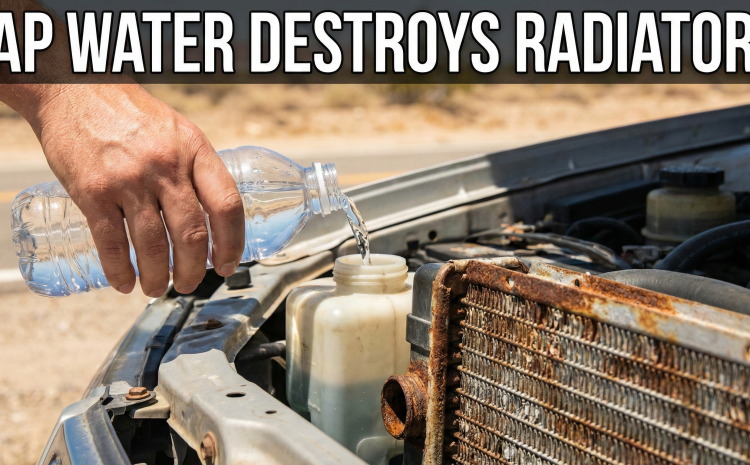
Why Tap Water is Your Radiator’s Worst Enemy: A Silent Killer Under the Hood
By Smart Garage Technical Team | Category: Maintenance & Diagnostics
Why Water Can’t Take the Heat
To understand why tap water is so dangerous, we must first look at the physics of heat transfer. An internal combustion engine is essentially a controlled explosion chamber. Temperatures inside the combustion chamber can reach over 2,000°C. While the cooling system doesn’t handle that peak heat directly, the metal surrounding the engine block easily sustains temperatures well above 100°C.
Here lies the first problem: Standard water boils at 100°C (212°F).
In the intense climate of the UAE, your engine operates on the razor’s edge of this temperature. Proper engine coolant (antifreeze/antiboil) is chemically engineered to have a much higher boiling point—often exceeding 123°C (253°F) when under pressure. This extra buffer is critical.
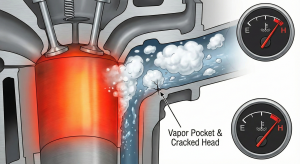
When you introduce tap water into this environment, it boils prematurely. Boiling water turns into steam, and steam is a gas, not a liquid. Unlike liquid, steam cannot absorb heat effectively. This creates “vapor pockets” or “hot spots” inside the engine head. While your temperature gauge might show a stable reading, these localized hot spots can warp the cylinder head, crack the engine block, or blow the head gasket—failures that often cost more to fix than the value of the car.
The “Clogged Arteries” of Your Machine
If the heat doesn’t kill your engine immediately, the chemistry of tap water will kill it slowly. This is best explained using the analogy of the human body.
Think of your car’s radiator and cooling passages as the circulatory system, and the coolant as the blood. In a healthy system, the fluid flows freely, regulating temperature and keeping the “heart” (engine) functioning. However, tap water is loaded with minerals—specifically calcium, magnesium, and limestone. This is what we call “hard water.”
When this mineral-rich water is heated and circulated, those minerals precipitate out of the liquid and bake onto the hot metal surfaces of your radiator tubes and engine water jackets. This process forms scale, which is identical to the white, crusty buildup you might see inside an old kitchen kettle.
The Progression of the Disease:
- Stage 1: Insulation. Scale acts as an insulator. It coats the inside of the radiator, preventing the heat from escaping into the air. Your engine is producing heat, but the radiator can no longer release it.
- Stage 2: Restriction. As the scale thickens, the tubes inside the radiator narrow—just like cholesterol clogging an artery.
- Stage 3: Cardiac Arrest. Eventually, the flow of coolant becomes so restricted that the water pump cannot push fluid through. The engine overheats rapidly, leading to seizure.
The Hidden Danger: Impact on Advanced Diagnostics & Electrical Systems
This is the aspect of radiator maintenance that most general mechanics overlook, but as experts in Advanced Diagnostics & Electrical Services, we see it constantly. You might ask: How does dirty water affect my car’s electronics?
Modern vehicles, from Toyotas to BMWs, are “computers on wheels.” The cooling system is no longer just mechanical; it is monitored and managed by a network of sensitive electrical components.
1. Electrolysis and “Stray Voltage”
When tap water creates rust and corrosion, the cooling fluid turns into an electrolyte essentially, a battery acid. As the fluid circulates, it can actually generate a small electrical charge (stray voltage). This voltage can confuse the Engine Control Unit (ECU), leading to erratic sensor readings. We have seen cases where a car was misdiagnosed with a faulty computer, when in reality, the “electrical noise” was coming from rusty coolant interfering with ground connections.
2. Sensor Failure
Your vehicle relies on the Engine Coolant Temperature (ECT) sensor to adjust fuel injection and ignition timing. If scale builds up on the tip of this sensor, it insulates it. The sensor might tell the computer the engine is cold (when it is actually hot), causing the computer to dump excess fuel into the engine. This leads to poor fuel economy, increased emissions, and eventually, catalytic converter failure.
3. Electric Water Pumps and Thermostats
Many modern European cars use electric water pumps rather than belt-driven ones. These pumps are sensitive precision instruments. The grit and rust particles from tap water corrosion act like sandpaper, destroying the internal impellers and seizing the electric motors. When this happens, it triggers a cascade of electrical warning lights that require sophisticated diagnostic tools to pinpoint.
The Realistic Solution: Coolant Flush vs. Replacement
So, what should you do if you have used tap water in an emergency? Is the engine doomed? Not necessarily, but time is of the essence.
Option A: The Cost-Effective “Detox” (Coolant Flush)
If caught early, the solution is a professional cooling system flush. This is not simply draining the radiator and refilling it. At Smart Garage, we use pressurized machines that circulate cleaning agents through the entire block, heater core, and radiator.
- The Process: We strip away the early layers of scale and rust.
- The Refill: We refill the system with manufacturer-specified coolant mixed with distilled water. This fluid contains lubricants for your water pump and inhibitors to stop rust from returning.
- The Cost: This is a fraction of the cost of a repair. It is preventative maintenance that pays for itself immediately.
Option B: The Expensive Reality (Radiator Replacement)
If the “clogged artery” stage has been reached, a flush might not be enough. Once rust has eaten through the metal (corrosion), flushing the system might actually reveal leaks that were temporarily plugged by the rust itself. In this scenario, replacing the radiator is the only option to save the engine.
This reinforces why a proper coolant flush is cheaper than replacing a rusted radiator. A radiator replacement involves parts, significant labor to remove bumpers and condensers, and downtime. A flush is quick, affordable, and effective.
Expert Tips for UAE Drivers
1. Check the Color: Healthy coolant is vibrant—Green, Pink, Orange, or Blue (depending on the make). If your coolant looks brown, muddy, or rusty, your radiator is already corroding.
2. Never Mix Colors: Never mix Green coolant (IAT) with Orange coolant (OAT). They use different chemical technologies. Mixing them causes a chemical reaction that turns the fluid into a thick gel or “sludge” that blocks the engine instantly.
3. Use Distilled Water Only: If you absolutely must top up your coolant and don’t have premixed antifreeze, use Distilled Water. It lacks the minerals that cause scale. However, visit a garage immediately to get the proper mixture restored.
4. Listen to Your Fan: If your cooling fan is running at full speed constantly, even when the weather isn’t extreme, it’s a sign your radiator isn’t exchanging heat efficiently.
Conclusion: Don’t Let Water Bankrupt Your Engine
Your vehicle is an investment, and in the harsh climate of the UAE, the cooling system is its most vital defense. While pouring tap water into your radiator might feel like a quick fix in an emergency, it is a gamble with very high stakes. It acts as a slow poison, clogging the arteries of your engine, confusing your electrical sensors, and eating away at the metal from the inside out.
Don’t wait for the steam to tell you something is wrong. If you have ever used tap water, or if it has been more than two years since your last coolant service, it is time for a check-up.
At Smart Garage, we combine mechanical expertise with cutting-edge technology. Whether you need a simple routine flush or complex Advanced Diagnostics & Electrical Services to trace sensor faults caused by overheating, our team is ready to help. We utilize OEM-grade tools to ensure your car leaves our workshop cooler, smoother, and more reliable than ever.
Is your car running hotter than usual? Don’t risk a breakdown.
Book Your Cooling System Inspection Today