Searching for a garage near me in the United Arab Emirates is only the first step. If you are unsure what to tell the workshop, a short, clear description of the car and the problem can help the team understand your request before you arrange a visit. You do not need to identify the fault yourself. Your observations are useful, but they are not a substitute for a professional diagnosis.
Before contacting a workshop in Sharjah, Dubai or elsewhere in the UAE, note your vehicle’s make and model, what you have noticed, when it began and whether any warning lights are showing. Sharing those basics gives the workshop a clearer starting point and helps you ask practical questions about the next step.
What should you tell a garage near me before booking?
Start with the details that identify the vehicle and explain your concern. If you are sending a message or speaking to someone at the workshop, having these notes ready can make the conversation easier and reduce the chance of forgetting something important.
- Vehicle make and model: Include the model name and, if you know it, the model year. Mention whether it is a hybrid or electric vehicle, as well as any relevant trim or engine details you can confirm.
- The concern in plain language: Describe what the car is doing, such as making a sound, feeling different to drive or showing a warning light. Use your own words rather than trying to name a mechanical fault.
- When it began: Say when you first noticed the issue and whether it appeared suddenly or developed over time. If it comes and goes, explain that too.
- Warning lights or messages: Report the symbol or wording as accurately as you can. If you are not sure what it means, say that rather than guessing.
- What you have already noticed: For example, mention whether the concern happens only at start-up, during a journey, when the car is stationary, or under another condition you have observed.
You do not need to provide every detail at once. The goal is to give the workshop a useful outline, not a technical report. If you do not know the vehicle year or the exact warning message, be clear about that. A straightforward “I’m not sure” is more useful than an inaccurate guess.
How to describe the concern without guessing at the fault
Describe what you can see, hear, smell or feel, and keep your explanation separate from any theory about the cause. For instance, “I hear a repeated knocking sound when the car is moving slowly” is more helpful than “the suspension has failed”. The first statement shares an observation. The second names a diagnosis that still needs to be checked.
Think about the conditions in which you notice the issue. Does it happen just after starting the car, while it is parked, or during a journey? Is it constant, or does it come and go? Does it happen only when you use a particular control? You may not be able to answer every question, and that is fine. Do not deliberately repeat a problem if doing so could put you or other road users at risk.
It can also help to describe what has changed. Perhaps the car behaves differently from usual, or a sound has become more noticeable. Avoid overstating how serious the issue is if you are unsure. A calm description gives the workshop information to assess, without pushing the conversation towards an assumed repair.
If you have already had the vehicle inspected or repaired, mention that and share any relevant paperwork you have. Explain what work was done and when, if known. Previous work may provide useful context, but it does not by itself establish the cause of a new or continuing concern.
Choosing a suitable garage near me in the UAE
Nearby is convenient, but it is worth checking that the workshop is suitable for your vehicle and the kind of concern you have. Consider whether it offers diagnostics, repairs and maintenance for your type of car, and whether its service approach is clear. If you drive a luxury, family, hybrid or electric vehicle, ask whether the workshop can assess that vehicle type before arranging a visit.
Smart Garage UAE is a Sharjah-based technical workshop offering diagnostics, repairs, maintenance and transparent service for luxury and family vehicles. If you are weighing up options around Sharjah or Dubai, this guide to choosing a garage near me covers factors to consider when selecting a nearby workshop.
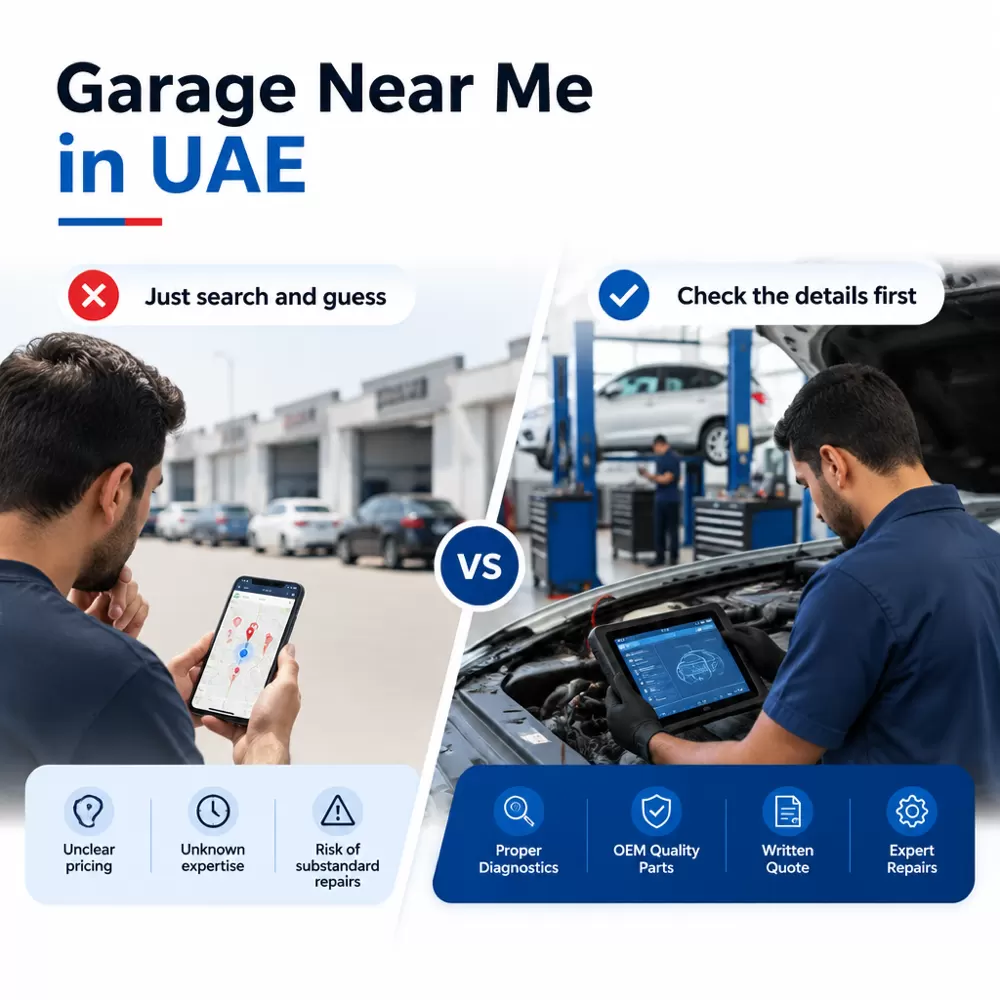
Before agreeing to work, ask what the proposed inspection involves and how the workshop will explain its findings. A professional diagnosis means checking the vehicle to identify the cause, rather than relying on a brief symptom description alone. Ask whether you will receive a written quote before repair work begins, and clarify what the quote includes. If parts are relevant, you can ask what parts are proposed, including whether OEM parts are available for the job.
These questions are not a demand for a diagnosis before the car has been checked. They help you understand the process and the likely next step. A workshop should be able to explain what it knows, what still needs inspection and when it can provide a more informed recommendation, without presenting an unverified cause as certain.
What to check and note before you contact a workshop
A few minutes of preparation can make your first conversation more useful. Keep your notes factual and short. If several things seem wrong, list them separately rather than blending them into one description.
- Write down the vehicle details. Note the make, model and year if known. Include whether the vehicle is a hybrid or EV, and share any other details you can confirm from the vehicle documents.
- Describe each concern separately. Say what you noticed, not what you think has failed. If there are two unrelated symptoms, identify them as separate points.
- Record the timeline. Note when each issue started, whether it has changed and how often you notice it. “I noticed it this week” is useful if you cannot remember the exact date.
- Copy warning messages accurately. If a symbol or message appears, write down its wording or describe the symbol. Do not rely on memory if you can safely check it while the vehicle is parked.
- Gather relevant history. If the car has recently been serviced, repaired or inspected, mention it. Share documents only if they are relevant and available.
- Prepare your practical questions. Ask what information the workshop needs, whether an inspection is required before a quote can be prepared, and how findings and costs will be explained.
Keep the notes accessible, but do not attempt to collect information while driving. If taking a photograph of a dashboard warning would help you remember it, do so only when the vehicle is safely parked. The workshop can ask follow-up questions if it needs more detail.
Which UAE driving details are useful to mention?
Drivers in the UAE may use their vehicles in very different ways, even within the same city. If you think a concern is connected to a particular journey or driving condition, describe that condition rather than making a technical conclusion. For example, say whether you notice the issue during short trips, in slow traffic or after a longer journey, if you have observed a clear pattern.
For an air-conditioning concern, explain what you have noticed about the cooling and when it occurs. For a noise, describe when it is audible and whether it changes with the car’s movement. For a warning light, report when it appeared and whether it remains visible. These are examples of useful observations, not ways to identify a fault remotely.
Be careful not to treat a pattern as proof of a cause. The same symptom can have more than one possible explanation, and some issues may not be obvious from a short description. The workshop needs to inspect or run appropriate diagnostics before it can give a reliable assessment.
If the concern affects how safely you can drive, say so plainly when you contact the workshop. Do not continue a journey simply to gather more details. If you are uncertain whether it is safe to drive, seek appropriate professional advice before setting off.
What happens after you explain the issue?
Your description helps the workshop understand why you are getting in touch, but it cannot confirm what is wrong with the vehicle. The next step may involve an inspection, diagnostic checks or further questions. Which checks are appropriate depends on the vehicle and the symptoms, so avoid expecting a firm repair recommendation from a few details alone.
Once the vehicle has been assessed, ask the workshop to explain its findings in plain language. You should be able to understand what was checked, what the results suggest and which work is being recommended. If the cause remains uncertain, ask what still needs to be investigated. This is more informative than agreeing to work based only on a guessed fault.
Before authorising a repair, review the written quote and ask about anything you do not understand, including the parts and work listed. Confirm whether further approval will be requested if the inspection reveals additional work. Transparent pricing means you can see what is proposed before deciding, rather than having to infer the cost from a general description.
After work is completed, ask what was done and whether any follow-up checks or observations are recommended. If the original concern remains, describe what you notice without assuming why it continues. Clear communication works in both directions: your observations help the workshop assess the car, and a clear explanation of the findings helps you make an informed decision.
A simple next step when searching for a garage near me
Before you arrange a visit, prepare a short summary: your vehicle’s make and model, the concern in everyday language, when it began, any warning lights and the conditions in which you have noticed it. Keep it factual and mention anything relevant you have already observed. You do not need to know the cause.
Then check that the nearby workshop is suitable for your vehicle and can explain its diagnostic and repair process. Ask how it will share its findings and provide a written quote before work is approved. This gives you a more useful starting conversation and helps set clear expectations, while leaving the diagnosis to a qualified workshop after it has assessed the vehicle.
Give the workshop clear observations, not a guessed diagnosis. Your notes can guide the first conversation, but an inspection is needed to establish the cause.