

Is It Just a Scratch? Why Ignoring Minor Car Damage Can Cost You Thousands Later
You have likely experienced it before: you return to your vehicle parked in a busy lot in Al Barsha or Downtown Dubai, only to find a fresh, unsightly white streak across your bumper. Or perhaps you misjudged a high curb near Jumeirah Beach, leaving a nasty scuff on your alloy wheel. In the fast-paced life of the UAE, where our cars are often our second homes, the temptation to ignore these “minor” cosmetic issues is overwhelming. We tell ourselves it is just a flesh wound, a cosmetic flaw that does not affect how the car drives. We promise ourselves we will fix it “someday.”
The Environmental Imperative: The Science of Vehicle Degradation in the UAE
To understand why a scratch is never “just a scratch” in Dubai, one must look at the science of automotive paint and how it interacts with our extreme environment. Your car’s paintwork is a sophisticated multi-layered system designed to flex and expand with the metal underneath. When that system is compromised, the clock starts ticking.
1. The Thermodynamics of Paint Failure
The UAE is home to some of the highest ambient temperatures in the world. During summer, the surface temperature of a dark-colored vehicle can easily exceed 70°C to 80°C. Metal expands when heated and contracts when cooled. In a healthy panel, the paint expands elastically along with the metal. However, a deep scratch creates a “stress fracture” in this protective skin. As the metal expands under the midday sun, the edges of the scratch cannot stretch uniformly. This leads to micro-cracking and delamination, where the clear coat begins to peel away from the base coat, causing the damage to spread like a contagion.
2. The Corrosive Triad: Salt, Humidity, and Sand
Many drivers mistakenly believe that rust is only a problem in rainy or snowy climates. This is a dangerous misconception. The UAE’s coastal geography means our air is thick with saline humidity—moisture carrying dissolved salt. When a scratch penetrates the primer and exposes bare metal, this salty air acts as an electrolyte, triggering rapid oxidation (rust). Adding to this is the omnipresent desert sand. Sand particles are hygroscopic, meaning they absorb and hold moisture. When sand gets lodged inside a scratch, it keeps that corrosive, salty moisture pressed against the bare metal 24/7, accelerating “under-creep” corrosion that spreads invisibly beneath your paint.
The Economic Reality: Calculating the “Cost of Ignoring”
While the physical damage is concerning, the financial hit is often immediate and painful, particularly when you decide to sell your vehicle or trade it in.

The Depreciation Multiplier
Vehicles in the UAE already face steep depreciation curves, often losing 20-30% of their value in the first year. Physical damage acts as a depreciation multiplier. When a prospective buyer or a dealership appraiser sees external damage, a psychological phenomenon known as the “Halo Effect” kicks in. They subconsciously assume that if the cosmetic condition of the car has been neglected, the mechanical maintenance (like oil changes and brake services) has likely been ignored as well.
Dealerships do not simply deduct the cost of the repair from your trade-in value; they deduct the “retail” cost of the repair plus a margin for their inconvenience. A bumper scuff that might cost AED 350 to fix at a specialist shop could result in an AED 1,500 deduction from your trade-in offer. By fixing the car before you sell, you are essentially buying back your car’s value at a discount.
The Insurance Trap: Why Filing a Claim Often Does Not Pay
A common question we face is, “Should I just claim this on my insurance?” For minor bodywork, the math rarely works in your favor. Let’s break down the typical costs associated with a minor “unknown accident” claim (e.g., parking lot damage where the other driver left):
- Police Report Fee: To file an insurance claim in Dubai, you typically need a police report. For an “unknown accident,” the fee via the Dubai Police app is approximately AED 400-420.
- Insurance Excess (Deductible): Most comprehensive policies have a compulsory excess you must pay for any claim where you are at fault or the other party is unidentified. This usually ranges from AED 350 to AED 1,000 depending on your policy.
- Loss of No Claims Bonus (NCB): Filing a claim resets your claim-free history, which can hike your premium by 15-20% upon renewal.
The Verdict: If you have a scratch that costs AED 400 to repair professionally using SMART technology, filing a claim could cost you over AED 1,000 in immediate fees and future premiums. Paying out of pocket is often the mathematically superior choice.
The Regulatory Roadblock: RTA Inspection Failure
In Dubai, vehicle safety is paramount, and the Roads and Transport Authority (RTA) enforces strict standards during the annual vehicle registration renewal. Many drivers are shocked to learn that “visible body damage” is a valid criterion for inspection failure.
Inspectors are trained to reject vehicles with:
- Sharp Edges: Any dent or scratch that creates a jagged metal edge is considered a safety hazard to pedestrians.
- Obscured Lights: Scuffs that cover reflectors or cracks in tail light lenses (even if the light still works) are automatic failures.
- Structural Aesthetics: Deep dents in pillars or bumpers can be flagged as potential structural compromises.
Failing your RTA test days before your registration expires puts you in a position of weakness. You are forced to make a “distress purchase,” paying premium rates for rush repairs just to keep your car legal. Proactive maintenance puts you back in the driver’s seat of your schedule and budget.
Modern Solutions: The Shift from Panel Beating to SMART Repair
Gone are the days when fixing a dent meant leaving your car at a workshop for a week and repainting the entire side of the vehicle. Technology has revolutionized the industry, allowing for faster, cheaper, and higher-quality repairs.
What is SMART Repair?
Small to Medium Area Repair Technology focuses on the specific area of damage. Instead of respraying a whole door, technicians use airbrushes and specialized solvents to blend new paint into the existing finish seamlessly. This uses less material, takes less time (often same-day service), and keeps the repair cost lower than your insurance excess.
Paintless Dent Removal (PDR)
For those annoying door dings caused by careless neighbors, PDR is the gold standard. If the paint surface is not broken, skilled technicians can massage the metal back into its original shape from behind the panel. This method requires no body filler and no painting, meaning your car retains its original factory paintwork—a massive plus for resale value.
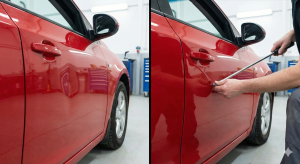
Actionable Tips: How to Assess Your Car’s Damage
Not every mark requires a trip to the body shop. Here is a simple “Fingernail Test” you can perform at home to gauge the severity of a scratch:
- Clean the scratched area with a soft microfiber cloth to remove surface dirt.
- Run your fingernail perpendicularly across the scratch.
- If your nail glides over it without catching: The scratch is likely just in the clear coat. This can often be fixed with professional buffing and polishing for a fraction of the cost of painting.
- If your nail catches in the groove: The scratch has penetrated the clear coat and likely the color coat. This requires professional attention to prevent rust and peeling.
- If you see gray or silver: You are down to the primer or bare metal. This is an urgent repair priority to prevent corrosion.
Conclusion: Protect Your Asset, Don’t Just Drive It
Your vehicle is likely the second most valuable asset you own. Ignoring bodywork damage is akin to ignoring a leak in your roof—it does not resolve itself; it only gets more expensive with time. In the harsh climate of the UAE, time is the enemy of damaged paint.
By addressing minor scratches, scuffs, and dents immediately, you avoid the “depreciation trap,” skip the hassle of expensive insurance claims, and ensure you sail through your next RTA inspection. At Smart Garage, we combine state-of-the-art color matching technology with old-school craftsmanship to return your vehicle to showroom condition.
Don’t let a minor scratch turn into a major headache. Take a photo of your car’s damage today and reach out to a professional. It is usually faster, cheaper, and easier than you think to get that new-car feeling back.