
Skip to content
Call WhatsApp
Car AC Not Cooling in Sharjah? Prepare Before Booking

AC & Cooling · 9 November 2026

Car AC Not Cooling in Sharjah? Prepare Before Booking

If your car’s air conditioning is not cooling properly in Sharjah, a few clear details can make your first conversation with a…

If your car’s air conditioning is not cooling properly in Sharjah, a few clear details can make your first conversation with a repairer more useful. Before arranging a booking in Al Nahda or Muwaileh, note what the system is doing, when the problem occurs and whether the car has had AC work before.

That preparation does not diagnose the fault or guarantee a particular repair. It helps the workshop understand the issue, ask relevant questions and explain what needs checking. This guide covers what to report, which vehicle details to have ready and what to confirm directly before travelling for car AC repair in Sharjah.

Describe what the car AC is doing, not just that it is warm

“The AC is not cold” is a good starting point, but a short description of the pattern can be more helpful. Think about what you notice during a normal drive in Sharjah. Does the air stay warm from the moment you switch the system on, or does it cool briefly and then become warm? Does the temperature change after the car has been moving for a while, or when you are stopped in traffic?

Try to describe the conditions rather than guess at a cause. A driver may suspect the system needs gas, but warm air can have more than one explanation. AC gas, also called refrigerant, is the fluid that carries heat through the air-conditioning system. A refill may be relevant in some cases, but the symptom alone does not show whether refrigerant is low or why. A technician needs to assess the system before recommending work.

Before you call, make a few notes:

  • How long the air takes to cool, or whether it does not cool at all.
  • Whether the problem changes between a slow drive, steady driving and being stopped.
  • Whether the airflow feels weak, even when the fan is turned up.
  • Whether the left and right vents feel different, if you have checked them.
  • Any unusual sound when the AC is switched on, and whether it continues or comes and goes.
  • Whether the issue is constant or has appeared intermittently.

There is no need to run repeated tests or keep changing settings just to create a more detailed report. Note what you have already observed in ordinary use. If the fault is intermittent, say so and explain when you last noticed it. That is more useful than presenting a guess as a confirmed diagnosis.

Share any previous AC repair or refill history

Tell the workshop about AC work carried out previously, even if it was some time ago or the repair was done elsewhere. Mention whether the system has had an AC gas refill, compressor service or another repair, and roughly when it happened if you know. If you have an invoice or service record, keep it nearby so you can describe what was done without relying on memory.

Timing matters. For example, if the AC cooled after a previous refill but later became warm again, report that sequence. It does not prove there is a leak or identify a failed component. It does give the technician useful context and helps avoid treating a repeated symptom as a completely new complaint.

Also mention any recent changes you noticed around the same time as the AC problem. That could be a new noise, a change in airflow, or the fault beginning after earlier AC work. Keep the account factual: what changed, when you noticed it and whether it has happened more than once. Avoid naming a repair you think is needed unless a technician has already confirmed it.

If you do not know the repair history, say that plainly. Do not feel you need to find an old invoice before making an enquiry. You can still explain the current symptoms and provide the vehicle details you do have. The workshop can advise what information is useful next and whether the car needs an inspection before any repair is discussed.

A useful booking note is a short timeline: what the AC did first, what it does now and what work, if any, has already been carried out.

Have the right vehicle details ready for car AC repair in Sharjah

Give the workshop enough information to identify the vehicle accurately. The make, model and model year are a sensible starting point. If you know the engine or trim, include it, particularly if the model is sold in more than one configuration. For a Japanese, German, British, American or luxury vehicle, do not assume that a model name alone tells the workshop every detail of its AC system.

Some refrigerants and system parts vary by vehicle. If you have a handbook, a previous repair invoice or a vehicle record that lists the refrigerant type, you can mention what it says. Do not guess the refrigerant from the vehicle’s age or model. If you do not have that information, give the make, model and year and let the workshop advise whether it needs any further details.

Before contacting the repairer, gather what you can from this list:

  • Make and model, written as it appears on your vehicle documents.
  • Model year and, if known, engine or trim.
  • The AC symptom and when it occurs.
  • Any earlier AC refill, compressor service or related repair you know about.
  • A previous invoice or repair note, if it is easy to find.

You do not need to send every document or personal detail in an initial enquiry. Ask the workshop what it needs to identify the vehicle or prepare for the visit. If a particular system configuration is unclear, provide the additional information they request rather than trying to interpret technical labels yourself.

Confirm local service and booking details in Sharjah, UAE

Al Nahda and Muwaileh are both relevant to local searches for AC help, but a neighbourhood mention does not confirm a workshop’s exact location, directions or current availability. Before setting off, contact the repairer directly and check where the car should be taken. Confirm the current opening hours and whether a booking is needed, rather than relying on an old listing or assuming you can arrive at any time.

For details about the service in Al Nahda and Muwaileh, start with Smart Garage UAE’s page for car ac repair sharjah. The page covers car AC repair, AC gas refill and compressor service. Use it to understand the service context, then contact the workshop directly to confirm the location, booking process and any practical requirements before travelling.

When you speak with the team, check the details that affect your visit:

  • Which workshop location can handle your vehicle and AC concern?
  • What address should you use, and are there any arrival instructions?
  • Do you need to book before bringing the car in?
  • What are the current opening hours?
  • Should you bring any previous AC repair records or other vehicle information?

Do not assume that a service mention for Al Nahda or Muwaileh means a technician can come to your home, that there is an appointment slot available, or that a particular repair can be completed on the day. Those points depend on arrangements that should be confirmed directly. If you are travelling from another part of Sharjah, confirm the destination first so you do not make an unnecessary trip.

Ask how diagnosis, a quote and AC work will be handled
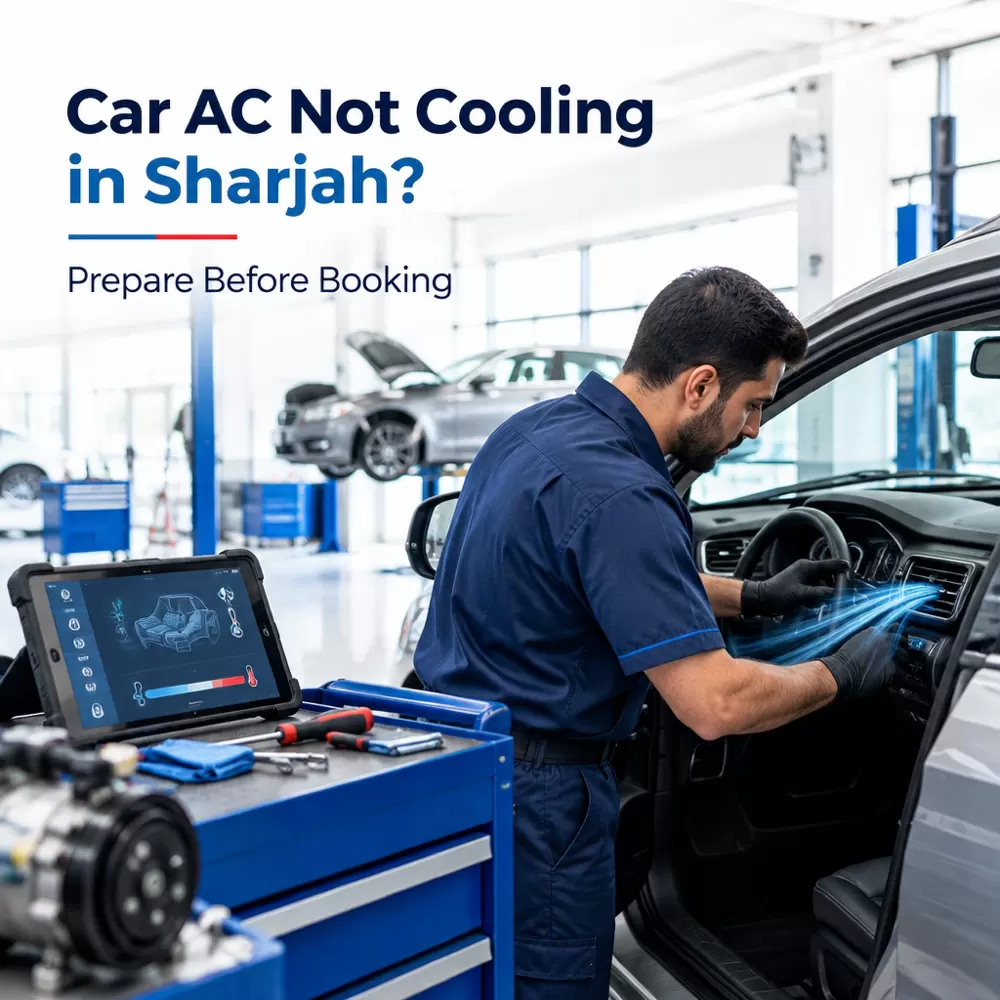
car ac repair sharjah by Smart Garage UAE

Before authorising work, ask what the next step will be after the technician hears your description. The symptoms help guide an assessment, but they do not establish that the car needs a gas refill, compressor service or another repair. A proper diagnosis means checking the system to identify what is causing the complaint before deciding on a repair.

Ask whether the workshop will explain the diagnostic findings and provide a written quote before carrying out recommended work. A useful quote should make clear what work is proposed and what parts or materials are included. If a part is required, ask whether an OEM part is available and what is included in the price. OEM refers to a part made to the vehicle manufacturer’s original specification; confirm the specific part and options for your car rather than assuming they are interchangeable.

It is also reasonable to ask whether the quote covers diagnosis, parts and labour, or whether any item is separate. If the assessment reveals a different fault from the one initially suspected, ask the workshop to explain the finding and seek your approval for any additional work before it proceeds. This gives you a clearer basis for deciding what to authorise and helps prevent a misunderstanding about the agreed price.

These questions are not a substitute for a technical inspection. They are a practical way to understand the proposed process and keep the repair decision clear. If the explanation is unclear, ask for it in plain language, including what has been checked and why the recommended work is relevant to the AC symptom you described.

Prepare for the visit and check the result

Once the workshop has confirmed where and when to bring the car, keep your symptom notes and any relevant repair records together. When you arrive, describe the issue in the same terms you used during booking. If the AC behaves differently at idle than while driving, or only fails after some time, mention that again. A short, consistent account is easier to work with than a long list of possible faults.

Before work starts, make sure you understand what has been approved and what the next communication will cover. If an assessment is needed before a quote can be finalised, confirm that with the team. Do not assume a price or completion time until it has been explained and agreed for your vehicle.

When the work is finished, ask what was found and what was repaired. If a refill or compressor service was carried out, ask for that work to be listed clearly on the invoice or repair record. Before leaving, check that the AC switches on and that the air feels cooler than before under the conditions you can safely test. This simple check cannot confirm every aspect of system performance, but it gives you a chance to raise an immediate concern while you are still at the workshop.

If the original symptom remains or returns, contact the workshop and describe what you notice, when it happens and how soon it returned. Avoid assuming that another refill is automatically the right next step. The repairer may need to reassess the system and explain what the next check involves.

For a smoother booking in Sharjah, prepare three things: a clear account of the AC symptom, the vehicle’s identifying details and confirmation of the location and booking arrangements. Those details help the workshop understand your concern without treating an early guess as a diagnosis, and help you arrive knowing what to expect.


 Car AC Not Cooling in Sharjah? Prepare Before Booking

Car AC Not Cooling in Sharjah? Prepare Before Booking

If your car’s air conditioning is not cooling properly in Sharjah, a few clear details can make your first conversation with a repairer more useful. Before arranging a booking in Al Nahda or Muwaileh, note what the system is doing, when the problem occurs and whether the car has had AC work before.

That preparation does not diagnose the fault or guarantee a particular repair. It helps the workshop understand the issue, ask relevant questions and explain what needs checking. This guide covers what to report, which vehicle details to have ready and what to confirm directly before travelling for car AC repair in Sharjah.

Describe what the car AC is doing, not just that it is warm

“The AC is not cold” is a good starting point, but a short description of the pattern can be more helpful. Think about what you notice during a normal drive in Sharjah. Does the air stay warm from the moment you switch the system on, or does it cool briefly and then become warm? Does the temperature change after the car has been moving for a while, or when you are stopped in traffic?

Try to describe the conditions rather than guess at a cause. A driver may suspect the system needs gas, but warm air can have more than one explanation. AC gas, also called refrigerant, is the fluid that carries heat through the air-conditioning system. A refill may be relevant in some cases, but the symptom alone does not show whether refrigerant is low or why. A technician needs to assess the system before recommending work.

Before you call, make a few notes:

  • How long the air takes to cool, or whether it does not cool at all.
  • Whether the problem changes between a slow drive, steady driving and being stopped.
  • Whether the airflow feels weak, even when the fan is turned up.
  • Whether the left and right vents feel different, if you have checked them.
  • Any unusual sound when the AC is switched on, and whether it continues or comes and goes.
  • Whether the issue is constant or has appeared intermittently.

There is no need to run repeated tests or keep changing settings just to create a more detailed report. Note what you have already observed in ordinary use. If the fault is intermittent, say so and explain when you last noticed it. That is more useful than presenting a guess as a confirmed diagnosis.

Share any previous AC repair or refill history

Tell the workshop about AC work carried out previously, even if it was some time ago or the repair was done elsewhere. Mention whether the system has had an AC gas refill, compressor service or another repair, and roughly when it happened if you know. If you have an invoice or service record, keep it nearby so you can describe what was done without relying on memory.

Timing matters. For example, if the AC cooled after a previous refill but later became warm again, report that sequence. It does not prove there is a leak or identify a failed component. It does give the technician useful context and helps avoid treating a repeated symptom as a completely new complaint.

Also mention any recent changes you noticed around the same time as the AC problem. That could be a new noise, a change in airflow, or the fault beginning after earlier AC work. Keep the account factual: what changed, when you noticed it and whether it has happened more than once. Avoid naming a repair you think is needed unless a technician has already confirmed it.

If you do not know the repair history, say that plainly. Do not feel you need to find an old invoice before making an enquiry. You can still explain the current symptoms and provide the vehicle details you do have. The workshop can advise what information is useful next and whether the car needs an inspection before any repair is discussed.

A useful booking note is a short timeline: what the AC did first, what it does now and what work, if any, has already been carried out.

Have the right vehicle details ready for car AC repair in Sharjah

Give the workshop enough information to identify the vehicle accurately. The make, model and model year are a sensible starting point. If you know the engine or trim, include it, particularly if the model is sold in more than one configuration. For a Japanese, German, British, American or luxury vehicle, do not assume that a model name alone tells the workshop every detail of its AC system.

Some refrigerants and system parts vary by vehicle. If you have a handbook, a previous repair invoice or a vehicle record that lists the refrigerant type, you can mention what it says. Do not guess the refrigerant from the vehicle’s age or model. If you do not have that information, give the make, model and year and let the workshop advise whether it needs any further details.

Before contacting the repairer, gather what you can from this list:

  • Make and model, written as it appears on your vehicle documents.
  • Model year and, if known, engine or trim.
  • The AC symptom and when it occurs.
  • Any earlier AC refill, compressor service or related repair you know about.
  • A previous invoice or repair note, if it is easy to find.

You do not need to send every document or personal detail in an initial enquiry. Ask the workshop what it needs to identify the vehicle or prepare for the visit. If a particular system configuration is unclear, provide the additional information they request rather than trying to interpret technical labels yourself.

Confirm local service and booking details in Sharjah, UAE

Al Nahda and Muwaileh are both relevant to local searches for AC help, but a neighbourhood mention does not confirm a workshop’s exact location, directions or current availability. Before setting off, contact the repairer directly and check where the car should be taken. Confirm the current opening hours and whether a booking is needed, rather than relying on an old listing or assuming you can arrive at any time.

For details about the service in Al Nahda and Muwaileh, start with Smart Garage UAE’s page for car ac repair sharjah. The page covers car AC repair, AC gas refill and compressor service. Use it to understand the service context, then contact the workshop directly to confirm the location, booking process and any practical requirements before travelling.

When you speak with the team, check the details that affect your visit:

  • Which workshop location can handle your vehicle and AC concern?
  • What address should you use, and are there any arrival instructions?
  • Do you need to book before bringing the car in?
  • What are the current opening hours?
  • Should you bring any previous AC repair records or other vehicle information?

Do not assume that a service mention for Al Nahda or Muwaileh means a technician can come to your home, that there is an appointment slot available, or that a particular repair can be completed on the day. Those points depend on arrangements that should be confirmed directly. If you are travelling from another part of Sharjah, confirm the destination first so you do not make an unnecessary trip.

Ask how diagnosis, a quote and AC work will be handled

car ac repair sharjah by Smart Garage UAE

Before authorising work, ask what the next step will be after the technician hears your description. The symptoms help guide an assessment, but they do not establish that the car needs a gas refill, compressor service or another repair. A proper diagnosis means checking the system to identify what is causing the complaint before deciding on a repair.

Ask whether the workshop will explain the diagnostic findings and provide a written quote before carrying out recommended work. A useful quote should make clear what work is proposed and what parts or materials are included. If a part is required, ask whether an OEM part is available and what is included in the price. OEM refers to a part made to the vehicle manufacturer’s original specification; confirm the specific part and options for your car rather than assuming they are interchangeable.

It is also reasonable to ask whether the quote covers diagnosis, parts and labour, or whether any item is separate. If the assessment reveals a different fault from the one initially suspected, ask the workshop to explain the finding and seek your approval for any additional work before it proceeds. This gives you a clearer basis for deciding what to authorise and helps prevent a misunderstanding about the agreed price.

These questions are not a substitute for a technical inspection. They are a practical way to understand the proposed process and keep the repair decision clear. If the explanation is unclear, ask for it in plain language, including what has been checked and why the recommended work is relevant to the AC symptom you described.

Prepare for the visit and check the result

Once the workshop has confirmed where and when to bring the car, keep your symptom notes and any relevant repair records together. When you arrive, describe the issue in the same terms you used during booking. If the AC behaves differently at idle than while driving, or only fails after some time, mention that again. A short, consistent account is easier to work with than a long list of possible faults.

Before work starts, make sure you understand what has been approved and what the next communication will cover. If an assessment is needed before a quote can be finalised, confirm that with the team. Do not assume a price or completion time until it has been explained and agreed for your vehicle.

When the work is finished, ask what was found and what was repaired. If a refill or compressor service was carried out, ask for that work to be listed clearly on the invoice or repair record. Before leaving, check that the AC switches on and that the air feels cooler than before under the conditions you can safely test. This simple check cannot confirm every aspect of system performance, but it gives you a chance to raise an immediate concern while you are still at the workshop.

If the original symptom remains or returns, contact the workshop and describe what you notice, when it happens and how soon it returned. Avoid assuming that another refill is automatically the right next step. The repairer may need to reassess the system and explain what the next check involves.

For a smoother booking in Sharjah, prepare three things: a clear account of the AC symptom, the vehicle’s identifying details and confirmation of the location and booking arrangements. Those details help the workshop understand your concern without treating an early guess as a diagnosis, and help you arrive knowing what to expect.

Leave a Reply

Your email address will not be published. Required fields are marked *

Smart Garage
Service Advisor
Online
Smart Garage
Hello! How can we help you with your car today? 👋
Just now
1