If you are looking for a Suzuki service center in Sharjah, the terms “minor service” and “major service” can make it hard to tell what work your car actually needs. They are useful labels, but they do not explain the exact checks, parts or repairs proposed for your vehicle.
At Smart Garage UAE’s Sharjah workshop, Suzuki owners can discuss diagnostics, maintenance and repairs with the team before work is authorised. This guide explains how to compare a minor and major service, what can change the proposed scope, and how to read an itemised estimate or turnaround time. The workshop should confirm current inclusions and pricing for your particular Suzuki, rather than relying on a generic list.
Why “minor” and “major” do not tell the whole story
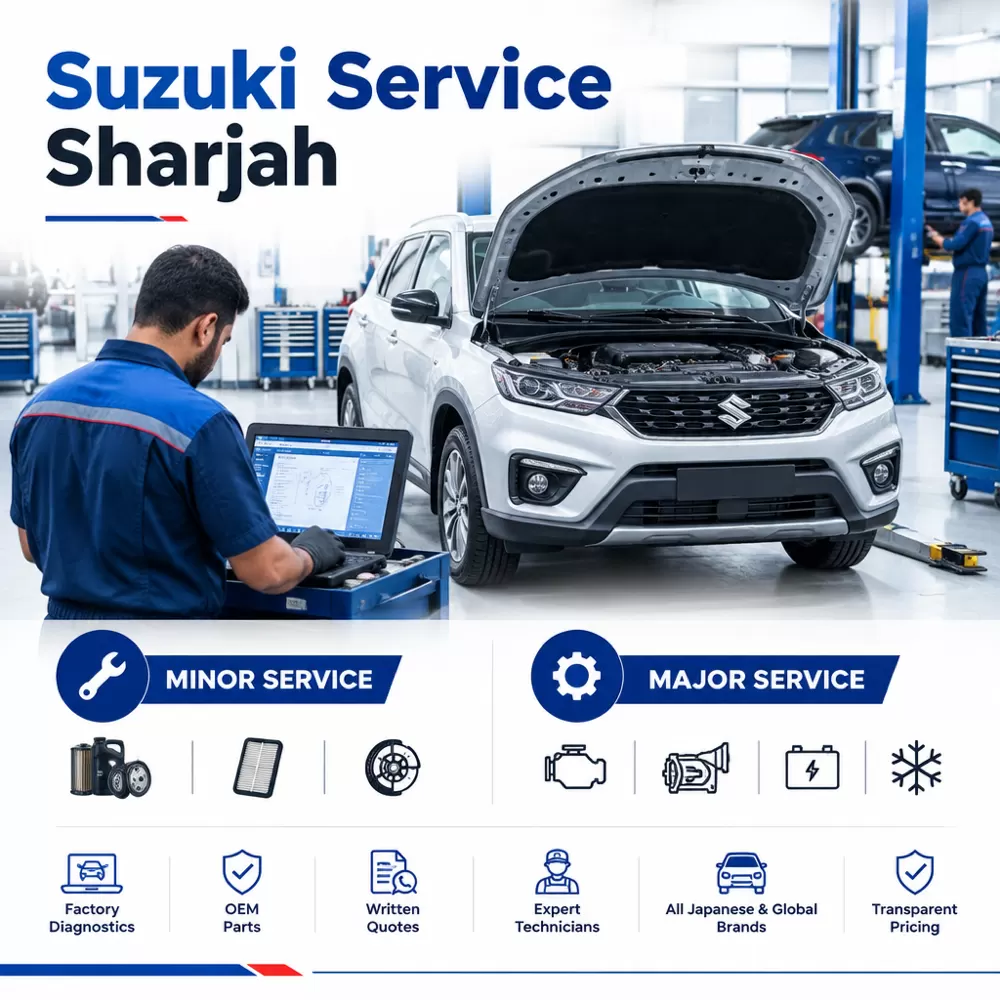
Service labels are shorthand, not a complete description of the work. A minor service usually signals a more limited maintenance visit than a major one, but the name alone does not confirm which checks or replacement items are included. Garages may also use different package names, so it is safer to compare the written scope than to assume two services with the same label are identical.
Your Suzuki’s needs depend on details such as its model, age, mileage, service history and current condition. A car with clear records and no reported symptoms may need a different plan from one with an overdue service, warning light or unusual noise. Even two cars of the same model can need different work if they have been driven or maintained differently.
For that reason, do not treat “major” as a promise that every possible maintenance item will be replaced, or “minor” as proof that a particular component has been checked. Ask the workshop to explain what each label means in its estimate. The useful comparison is the actual work proposed, not which package name sounds more thorough.
What a Suzuki minor and major service may cover
There is no single list that can safely be presented as the standard minor or major service for every Suzuki. The correct work and intervals depend on the model and the maintenance information that applies to it. The owner’s handbook and service records are useful starting points, but the workshop should confirm the relevant requirements for your vehicle before recommending a scope.
A limited service visit may focus on routine maintenance and a set of checks. A more extensive visit may include additional maintenance work or inspections. Those descriptions are only a broad way to understand the difference. They are not a promise of specific parts, fluids or labour, and they should not replace a vehicle-specific assessment.
When Smart Garage UAE proposes work, ask for the service items to be separated clearly. The estimate should help you understand which tasks are routine maintenance, which are inspections or diagnostic checks, and which are additional repairs suggested because of a finding. If a part is recommended for replacement, ask whether it is due under the relevant service information or whether its condition is the reason for the recommendation.
It is also reasonable to ask what is not included. For example, a service label may not include fault diagnosis, a repair found during inspection, or a replacement item that has not been approved. Confirm these limits before authorising the job so there is no confusion when the vehicle is ready.
How to understand the proposed service scope
Start with the concern that brought the car in. If you are booking routine maintenance, say so. If there is a warning light, vibration, noise, fluid leak or change in the way the car drives, describe when it happens and whether it is constant or intermittent. Those details can help the technician decide whether the visit needs a diagnostic step as well as scheduled maintenance.
Then ask the service adviser to explain each line of the proposed work in plain language. You should be able to distinguish the requested service from any additional recommendation. A useful estimate identifies the task, the reason for it and any parts or labour being charged. If the workshop needs to inspect or diagnose the car before confirming a repair, ask what that first stage involves and how you will be updated.
Smart Garage UAE describes its Sharjah facility as a technical workshop for diagnostics, repairs and maintenance, with transparent service. Its approach includes dealership-grade diagnostics, OEM parts where applicable and written quotes. To learn more about the workshop and its Suzuki service context, see the suzuki service center sharjah guide.
Before approving the work, check that the scope reflects what you discussed. If an additional repair appears after inspection, ask for the finding and revised estimate before it is carried out. You can also ask whether the car can be returned after the originally authorised tasks if you want time to consider an extra recommendation.
Why Suzuki service needs and prices vary in Sharjah, United Arab Emirates
The price of a service depends on what the vehicle needs and what the written scope includes. A simple maintenance visit and a visit that includes fault diagnosis or repair are not directly comparable. Parts, labour and the time needed to investigate a concern can all affect an estimate. Without inspecting the vehicle and confirming the work, it would not be reliable to quote a fixed fee for every Suzuki.
Condition matters as much as the service label. If inspection reveals a worn or damaged item, the workshop may recommend additional work, but it should explain the finding and price it separately from the original service where possible. A recommendation is not the same as an authorised repair. Ask what is urgent, what can be monitored and what the consequences of delaying the work may be, based on the technician’s assessment.
Local use can also be relevant when discussing the car’s condition. Driving in Sharjah may involve heat, dust, traffic and frequent short journeys, depending on the owner’s routine. These conditions do not create a universal Suzuki service schedule, and they do not automatically mean a component needs replacing. They are useful context for the technician, alongside the mileage, service history and symptoms you report.
For an accurate comparison, give the workshop the model, year, mileage and any available service records. Mention recent repairs and tell them if the car is used mostly for short trips or regular longer journeys. The workshop can then confirm which maintenance information applies and whether an inspection or diagnostic check is needed before the final scope is known.
How to read an itemised estimate and turnaround time
An itemised estimate should make it easier to see what you are paying for. Read each line and check whether it refers to inspection, maintenance, diagnosis, parts or repair labour. If parts are listed, ask what they are for and whether OEM parts are being quoted where applicable. If a line is unclear, request an explanation before approving the work.
Check whether the quoted amount is for the work already discussed or whether it is an initial estimate subject to inspection. Ask how the workshop will handle any additional finding. A clear process is to contact you with the issue, explain the proposed remedy and provide an updated price for approval. Do not assume that an inspection automatically authorises every repair that may be recommended.
Turnaround time should be treated as an estimate, not a fixed promise, unless the workshop confirms otherwise. The time needed can depend on the agreed scope, the diagnostic findings, parts availability and the workshop’s workload. Ask what the stated timeframe covers: initial assessment, approved maintenance, or completion of all proposed repairs. If parts need to be sourced or diagnosis uncovers another issue, ask how the revised timing will be communicated.
Before leaving the car, confirm the preferred contact method and whether the workshop will wait for your approval before proceeding with work outside the agreed scope. These details matter as much as the headline price. They help you compare estimates fairly and reduce the chance of a surprise charge or an unclear collection time.
What to do before and after your Suzuki service
A little preparation makes it easier for the workshop to assess the car and explain its recommendations. Before booking, gather the information that can affect the service plan:
- Write down the Suzuki model, year and current mileage.
- Bring or share service records if you have them, including details of recent maintenance or repairs.
- Describe any warning lights, unusual sounds, changes in handling or other symptoms, including when they occur.
- Ask for the proposed service scope, estimate and expected turnaround to be confirmed for your vehicle.
- Clarify how the workshop will seek approval if it finds additional work.
When collecting the car, ask for a summary of the work completed and a copy of the final invoice or job details. Compare the completed work with the approved estimate, especially if the scope changed during the visit. If a technician has advised monitoring an item rather than replacing it, ask what signs to watch for and when to have it checked again.
If a warning light remains on, a reported symptom has not changed, or the final paperwork does not match the work you authorised, raise it with the workshop before you leave if possible. Clear questions are appropriate; you do not need to interpret technical terms on your own. The team should be able to explain what was checked, what was repaired and what remains outstanding.
The most dependable way to choose between a Suzuki minor and major service is to compare the vehicle-specific work, not the label. Share accurate details, review the written estimate and confirm the expected timing with Smart Garage UAE’s Sharjah workshop. Current prices, inclusions and completion times should always be confirmed directly, because they can change with the car’s condition and the final scope of work.