Home About Services Brands Blog Contact
January 01, 2026 • battery services

Buying a Used Tesla in the UAE: The Definitive Guide to Checking Real Battery Health Before You Pay

It’s 2026, and the electric revolution has firmly taken hold of the UAE. Drive from Dubai Marina to Downtown, and you will likely lose count of the Tesla Model 3s, Model Ys, and refreshed Model S sedans silently gliding past.

With Tesla’s dominance in the region over the last five years, a robust and attractive used Tesla market in the UAE has emerged. For many smart buyers, picking up a three-year-old Model 3 Long Range for a fraction of its original new price is the perfect entry point into EV ownership.

The acceleration is thrilling, the tech is unmatched, and the fuel savings are immense. But for every prospective buyer scrolling through Dubizzle or checking dealership inventory, there is one massive, looming anxiety that keeps them up at night:

“What about the battery?”

It is the single most expensive component in the car. Unlike a combustion engine that might leak a bit of oil as it ages, a degraded battery means less range, longer charging times, and, in the worst-case scenario out of warranty, a replacement bill that can exceed AED 50,000.

Furthermore, we live in a unique environment. The extreme summer heat of the UAE puts stress on lithium-ion chemistry that cars in cooler climates don’t face.

If you are looking to buy a used Tesla in Dubai or Abu Dhabi, you cannot afford to guess about the battery’s condition. In this detailed guide, the EV specialists at Smart Garage will explain why you can’t trust the dashboard display, teach you the DIY methods for estimating health, and reveal how professional diagnostics provide the only definitive answer.

The Great Deception: Why You Can’t Trust the “Displayed Range”

The biggest mistake used Tesla buyers make is looking at the dashboard during a test drive and assuming the displayed range equals battery health.

The seller might say: “Look, it’s charged to 90% and shows 400km range. It’s practically brand new!”

Do not fall for this.

The range number displayed next to the battery icon on the Tesla screen (often called the “Guess-o-Meter” by enthusiasts) is not a direct measurement of the battery capacity in kilowatt-hours (kWh).

It is an algorithm based on estimates. It is influenced by:

  • Recent driving efficiency: If the previous owner drove slowly in cool weather, the estimate will be high. If they just blasted down Sheikh Zayed Road at 140 km/h with the AC on max, the estimate will be low.

  • Calibration drift: If the battery hasn’t been charged to 100% and discharged to near zero in a long time, the Battery Management System (BMS) loses track of the exact top and bottom buffers, leading to inaccurate estimates.

Relying on the dashboard range to judge Tesla battery health is like trying to guess how big a car’s fuel tank is based on how many kilometers it drove in stop-and-go traffic yesterday. It tells you nothing about the actual size of the tank.

To know if you are buying a good car, you need to know the actual remaining capacity of that “tank” in kWh.

Understanding Battery Degradation in the UAE Climate

Before checking a car, you need to know what is “normal.” All EV batteries degrade over time; it is a chemical reality. They lose capacity due to charging cycles and calendar aging.

However, heat is the enemy of lithium-ion batteries. While Tesla has one of the best thermal management systems in the business (actively cooling the battery pack), the sustained 45°C+ temperatures of a UAE summer mean the cooling system is working overtime. A car parked outside constantly in Jumeirah will likely show more degradation than one garaged daily in DIFC.

What is acceptable degradation? Based on data from thousands of Teslas globally and our experience in the UAE:

  • Year 1: Expect a steeper initial drop, perhaps 3-5%.

  • Subsequent Years: Degradation usually slows down to about 1% per year.

  • The 2026 Reality: A 3-year-old (2023 model) Tesla Model 3 in the UAE with average mileage showing 8% to 12% degradation is considered normal and healthy. Anything over 15% for that age warrants serious investigation.

Now, let’s look at how to measure it.

Method 1: The DIY “Quick Math” Check (The Estimate)

When you go to view a used Tesla in the UAE, you probably only have 30 minutes with the car. You can’t run complex tests. This method gives you a rough, “back-of-the-napkin” estimate to spot a major red flag.

How to do it:

  1. Get in the car and open the energy tab on the main screen.

  2. Note the current battery percentage and the current displayed range (ensure it’s set to km, not percentage).

  3. Ask the seller if you can charge the car to 100% on a nearby Supercharger (this is the best way).

  4. If you can’t charge to 100%, you need to extrapolate.

The Formula: (Current Displayed Range / Current Battery Percentage as a decimal) = Estimated 100% Range

Example: You are looking at a used 2022 Model 3 Long Range.

  • The battery is at 80%.

  • The displayed range is 380 km.

  • Calculation: 380 / 0.80 = 475 km (This is your estimated current full range).

Now, find the original rated range for that specific model year when new (e.g., let’s say it was 530 km WLTP rated).

  • 475 km (Current) / 530 km (New) = 89.6% Health.

  • This indicates roughly 10-11% degradation. For a 4-year-old car in the UAE, this is likely acceptable.

Limitations: As mentioned, this still relies on the car’s internal estimate, which can be flawed due to calibration issues. It is a useful first step, but not a definitive diagnosis.

Method 2: The Tesla “Service Mode” Test (The Gold Standard DIY)

Tesla has hidden a professional-grade battery health test inside the car’s software, accessible via the hidden “Service Mode.”

This test discharges the battery extensively and recharges it to measure precisely how many kilowatt-hours it can hold. It is highly accurate.

The massive catch: This test takes up to 24 hours to complete, and the car must be plugged into a Level 2 charger (like a Tesla Wall Connector) the entire time.

It is almost impossible to perform this test during a standard pre-purchase viewing unless the seller is incredibly cooperative and lets you take the car overnight.

For reference, here is the process:

  1. Enter Service Mode (go to Software menu, hold press on the model name “Model 3” for 3 seconds, release, and type “service”).

  2. Navigate to the High Voltage menu.

  3. Select “Health Test.”

  4. Follow instructions (car must be below 50% charge, plugged into AC power).

If you are buying from a friend or a very flexible seller, insist on this test. It will give you a percentage score (e.g., “91%”). If you are buying from a dealer or a standard private seller, this method is usually impractical.
Method 3: The Professional Route – Smart Garage EV Inspection

Given the limitations of the dashboard guess-o-meter and the impracticality of the 24-hour Service Mode test, how can a buyer get a fast, accurate answer?

The answer lies in professional diagnostics that talk directly to the car’s Battery Management System (BMS).

At Smart Garage, when we perform a pre-purchase inspection on a used Tesla, we bypass the dashboard estimates entirely.

How We Read the Real Data

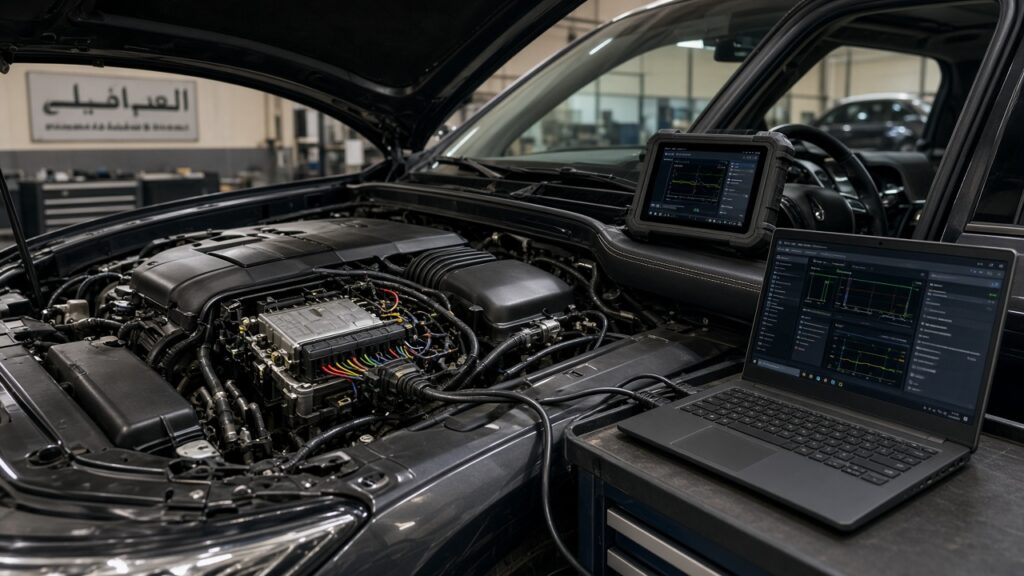
We utilize specialized OBD-II adapter harnesses (as Tesla doesn’t use standard ports) combined with advanced diagnostic software like Scan My Tesla or proprietary garage tools.

This allows us to read the raw data streams coming from the battery pack in real-time during a test drive. We don’t guess; we measure.

What Smart Garage Looks For:

1. Nominal Full Pack (kWh)

This is the holy grail number. It is the BMS’s own calculation of exactly how much energy the pack can hold right now when 100% full.

  • Example: A new Model 3 Long Range might have had ~78 kWh usable. If our scan shows the “Nominal Full Pack” is now 70 kWh, we know exactly how much degradation has occurred, regardless of what range the dashboard shows.

2. Cell Imbalance (The Hidden Killer)

A battery pack is made of thousands of individual cells. They must all charge and discharge at the same rate. If a few cell bricks are “weak,” they hit empty faster than the rest. The BMS has to stop the whole car based on the weakest link, severely limiting range even if the other 95% of the battery is healthy.

  • A DIY check cannot see this. Our diagnostic tools measure the voltage delta (difference) between cell groups. A high voltage difference indicates an unbalanced, unhealthy pack that may fail prematurely.

3. Lifetime DC Fast Charging vs. AC Charging

Our scans reveal the history of the car. Has this Tesla lived its life plugged into a Supercharger every day? Frequent DC fast charging generates high heat and accelerates degradation compared to slow AC home charging. Knowing this ratio tells us a lot about how the battery was treated.

4. Physical & Thermal Inspection

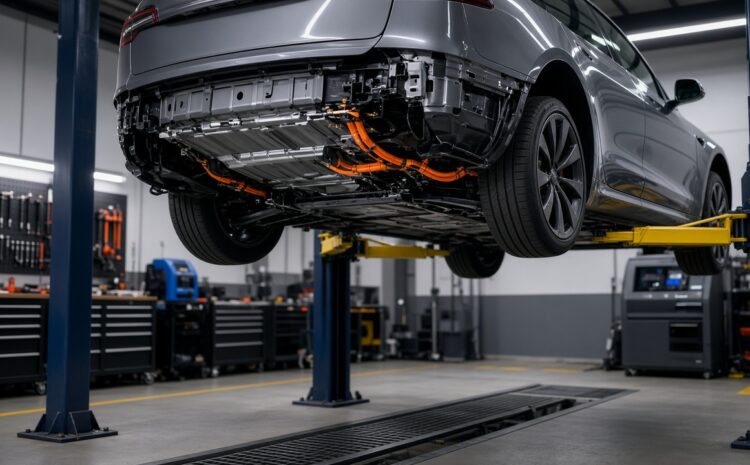
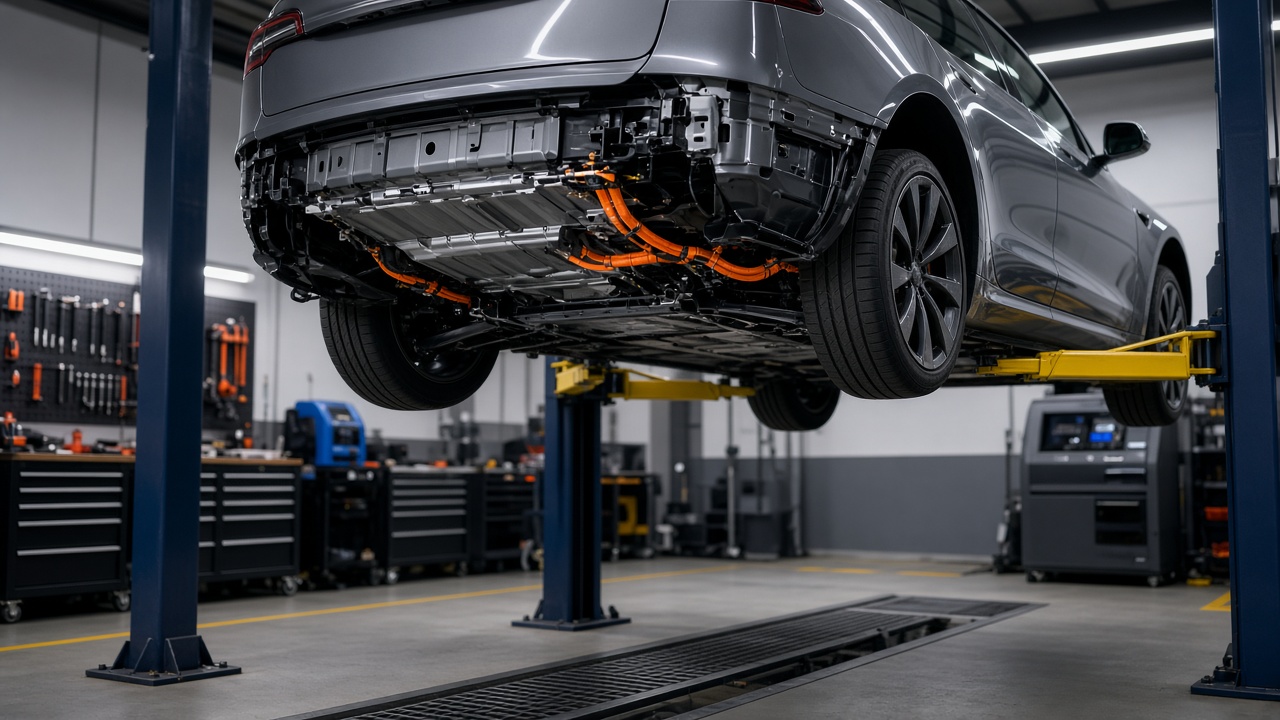
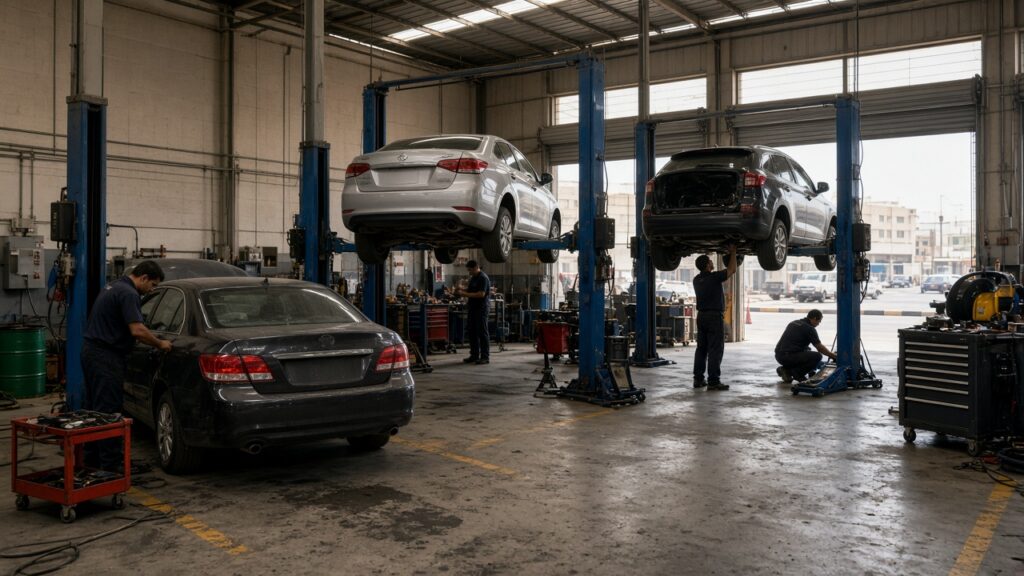
It’s not just about software. We put the car on a lift.

  • Physical Damage: We inspect the titanium underbody shield for massive dents. A severe impact on a speed bump or road debris can damage the battery casing, which is an automatic failure for Tesla’s warranty.

  • Cooling System: We pressure test the battery cooling loop. A small coolant leak in the UAE heat will destroy a battery quickly.

Don’t Forget the Warranty Clock

When buying used, always verify the remaining warranty. Tesla provides excellent coverage:

  • Standard Vehicle Warranty: 4 years / 80,000 km (whichever comes first).

  • Battery & Drive Unit Warranty: Usually 8 years / 160,000 km to 192,000 km (depending on model).

Crucially, this warranty covers the battery if degradation exceeds roughly 30% within that period.

If you are looking at a 2019 Model S that has 150,000km on the clock, that battery warranty is about to expire. You absolutely need a professional inspection before taking that risk. If you are looking at a 2023 Model Y, you have plenty of warranty buffer remaining.

Conclusion: Don’t Gamble with Your Investment

Buying a used Tesla in the UAE is one of the smartest automotive financial decisions you can make in 2026 provided you buy a good one.

The difference between a well-maintained Tesla with 10% degradation and an abused one with 20% degradation and cell imbalance is huge, both in your daily driving experience and future resale value.

Don’t rely on the seller’s word or the dashboard’s “Guess-o-Meter.”

Before you hand over the cash for your electric dream car, bring it to the experts in EV maintenance in Dubai. At Smart Garage, our specialized EV Pre-Purchase Inspection will give you the unvarnished truth about the battery’s health, ensuring your new Tesla is ready for many years of emission-free driving on UAE roads.
 Buying a Used Tesla in the UAE: The Definitive Guide to Checking Real Battery Health Before You Pay

Buying a Used Tesla in the UAE: The Definitive Guide to Checking Real Battery Health Before You Pay

It’s 2026, and the electric revolution has firmly taken hold of the UAE. Drive from Dubai Marina to Downtown, and you will likely lose count of the Tesla Model 3s, Model Ys, and refreshed Model S sedans silently gliding past.

With Tesla’s dominance in the region over the last five years, a robust and attractive used Tesla market in the UAE has emerged. For many smart buyers, picking up a three-year-old Model 3 Long Range for a fraction of its original new price is the perfect entry point into EV ownership.

The acceleration is thrilling, the tech is unmatched, and the fuel savings are immense. But for every prospective buyer scrolling through Dubizzle or checking dealership inventory, there is one massive, looming anxiety that keeps them up at night:

“What about the battery?”

It is the single most expensive component in the car. Unlike a combustion engine that might leak a bit of oil as it ages, a degraded battery means less range, longer charging times, and, in the worst-case scenario out of warranty, a replacement bill that can exceed AED 50,000.

Furthermore, we live in a unique environment. The extreme summer heat of the UAE puts stress on lithium-ion chemistry that cars in cooler climates don’t face.

If you are looking to buy a used Tesla in Dubai or Abu Dhabi, you cannot afford to guess about the battery’s condition. In this detailed guide, the EV specialists at Smart Garage will explain why you can’t trust the dashboard display, teach you the DIY methods for estimating health, and reveal how professional diagnostics provide the only definitive answer.

The Great Deception: Why You Can’t Trust the “Displayed Range”

The biggest mistake used Tesla buyers make is looking at the dashboard during a test drive and assuming the displayed range equals battery health.

The seller might say: “Look, it’s charged to 90% and shows 400km range. It’s practically brand new!”

Do not fall for this.

The range number displayed next to the battery icon on the Tesla screen (often called the “Guess-o-Meter” by enthusiasts) is not a direct measurement of the battery capacity in kilowatt-hours (kWh).

It is an algorithm based on estimates. It is influenced by:

  • Recent driving efficiency: If the previous owner drove slowly in cool weather, the estimate will be high. If they just blasted down Sheikh Zayed Road at 140 km/h with the AC on max, the estimate will be low.

  • Calibration drift: If the battery hasn’t been charged to 100% and discharged to near zero in a long time, the Battery Management System (BMS) loses track of the exact top and bottom buffers, leading to inaccurate estimates.

Relying on the dashboard range to judge Tesla battery health is like trying to guess how big a car’s fuel tank is based on how many kilometers it drove in stop-and-go traffic yesterday. It tells you nothing about the actual size of the tank.

To know if you are buying a good car, you need to know the actual remaining capacity of that “tank” in kWh.

Understanding Battery Degradation in the UAE Climate

Before checking a car, you need to know what is “normal.” All EV batteries degrade over time; it is a chemical reality. They lose capacity due to charging cycles and calendar aging.

However, heat is the enemy of lithium-ion batteries. While Tesla has one of the best thermal management systems in the business (actively cooling the battery pack), the sustained 45°C+ temperatures of a UAE summer mean the cooling system is working overtime. A car parked outside constantly in Jumeirah will likely show more degradation than one garaged daily in DIFC.

What is acceptable degradation? Based on data from thousands of Teslas globally and our experience in the UAE:

  • Year 1: Expect a steeper initial drop, perhaps 3-5%.

  • Subsequent Years: Degradation usually slows down to about 1% per year.

  • The 2026 Reality: A 3-year-old (2023 model) Tesla Model 3 in the UAE with average mileage showing 8% to 12% degradation is considered normal and healthy. Anything over 15% for that age warrants serious investigation.

Now, let’s look at how to measure it.

Method 1: The DIY “Quick Math” Check (The Estimate)

When you go to view a used Tesla in the UAE, you probably only have 30 minutes with the car. You can’t run complex tests. This method gives you a rough, “back-of-the-napkin” estimate to spot a major red flag.

How to do it:

  1. Get in the car and open the energy tab on the main screen.

  2. Note the current battery percentage and the current displayed range (ensure it’s set to km, not percentage).

  3. Ask the seller if you can charge the car to 100% on a nearby Supercharger (this is the best way).

  4. If you can’t charge to 100%, you need to extrapolate.

The Formula: (Current Displayed Range / Current Battery Percentage as a decimal) = Estimated 100% Range

Example: You are looking at a used 2022 Model 3 Long Range.

  • The battery is at 80%.

  • The displayed range is 380 km.

  • Calculation: 380 / 0.80 = 475 km (This is your estimated current full range).

Now, find the original rated range for that specific model year when new (e.g., let’s say it was 530 km WLTP rated).

  • 475 km (Current) / 530 km (New) = 89.6% Health.

  • This indicates roughly 10-11% degradation. For a 4-year-old car in the UAE, this is likely acceptable.

Limitations: As mentioned, this still relies on the car’s internal estimate, which can be flawed due to calibration issues. It is a useful first step, but not a definitive diagnosis.

Method 2: The Tesla “Service Mode” Test (The Gold Standard DIY)

Tesla has hidden a professional-grade battery health test inside the car’s software, accessible via the hidden “Service Mode.”

This test discharges the battery extensively and recharges it to measure precisely how many kilowatt-hours it can hold. It is highly accurate.

The massive catch: This test takes up to 24 hours to complete, and the car must be plugged into a Level 2 charger (like a Tesla Wall Connector) the entire time.

It is almost impossible to perform this test during a standard pre-purchase viewing unless the seller is incredibly cooperative and lets you take the car overnight.

For reference, here is the process:

  1. Enter Service Mode (go to Software menu, hold press on the model name “Model 3” for 3 seconds, release, and type “service”).

  2. Navigate to the High Voltage menu.

  3. Select “Health Test.”

  4. Follow instructions (car must be below 50% charge, plugged into AC power).

If you are buying from a friend or a very flexible seller, insist on this test. It will give you a percentage score (e.g., “91%”). If you are buying from a dealer or a standard private seller, this method is usually impractical.

Method 3: The Professional Route – Smart Garage EV Inspection

Given the limitations of the dashboard guess-o-meter and the impracticality of the 24-hour Service Mode test, how can a buyer get a fast, accurate answer?

The answer lies in professional diagnostics that talk directly to the car’s Battery Management System (BMS).

At Smart Garage, when we perform a pre-purchase inspection on a used Tesla, we bypass the dashboard estimates entirely.

How We Read the Real Data

We utilize specialized OBD-II adapter harnesses (as Tesla doesn’t use standard ports) combined with advanced diagnostic software like Scan My Tesla or proprietary garage tools.

This allows us to read the raw data streams coming from the battery pack in real-time during a test drive. We don’t guess; we measure.

What Smart Garage Looks For:

1. Nominal Full Pack (kWh)

This is the holy grail number. It is the BMS’s own calculation of exactly how much energy the pack can hold right now when 100% full.

  • Example: A new Model 3 Long Range might have had ~78 kWh usable. If our scan shows the “Nominal Full Pack” is now 70 kWh, we know exactly how much degradation has occurred, regardless of what range the dashboard shows.

2. Cell Imbalance (The Hidden Killer)

A battery pack is made of thousands of individual cells. They must all charge and discharge at the same rate. If a few cell bricks are “weak,” they hit empty faster than the rest. The BMS has to stop the whole car based on the weakest link, severely limiting range even if the other 95% of the battery is healthy.

  • A DIY check cannot see this. Our diagnostic tools measure the voltage delta (difference) between cell groups. A high voltage difference indicates an unbalanced, unhealthy pack that may fail prematurely.

3. Lifetime DC Fast Charging vs. AC Charging

Our scans reveal the history of the car. Has this Tesla lived its life plugged into a Supercharger every day? Frequent DC fast charging generates high heat and accelerates degradation compared to slow AC home charging. Knowing this ratio tells us a lot about how the battery was treated.

4. Physical & Thermal Inspection

It’s not just about software. We put the car on a lift.

  • Physical Damage: We inspect the titanium underbody shield for massive dents. A severe impact on a speed bump or road debris can damage the battery casing, which is an automatic failure for Tesla’s warranty.

  • Cooling System: We pressure test the battery cooling loop. A small coolant leak in the UAE heat will destroy a battery quickly.

Don’t Forget the Warranty Clock

When buying used, always verify the remaining warranty. Tesla provides excellent coverage:

  • Standard Vehicle Warranty: 4 years / 80,000 km (whichever comes first).

  • Battery & Drive Unit Warranty: Usually 8 years / 160,000 km to 192,000 km (depending on model).

Crucially, this warranty covers the battery if degradation exceeds roughly 30% within that period.

If you are looking at a 2019 Model S that has 150,000km on the clock, that battery warranty is about to expire. You absolutely need a professional inspection before taking that risk. If you are looking at a 2023 Model Y, you have plenty of warranty buffer remaining.

Conclusion: Don’t Gamble with Your Investment

Buying a used Tesla in the UAE is one of the smartest automotive financial decisions you can make in 2026 provided you buy a good one.

The difference between a well-maintained Tesla with 10% degradation and an abused one with 20% degradation and cell imbalance is huge, both in your daily driving experience and future resale value.

Don’t rely on the seller’s word or the dashboard’s “Guess-o-Meter.”

Before you hand over the cash for your electric dream car, bring it to the experts in EV maintenance in Dubai. At Smart Garage, our specialized EV Pre-Purchase Inspection will give you the unvarnished truth about the battery’s health, ensuring your new Tesla is ready for many years of emission-free driving on UAE roads.
Leave a Reply

Your email address will not be published. Required fields are marked *

Smart Garage
Service Advisor
Online
Smart Garage
Hello! How can we help you with your car today? 👋
Just now
1