Home About Services Brands Blog Contact
December 24, 2025 • Smart Garage Sharjah

Failed Your Tasjeel Test? 5 Common Reasons Cars Fail in Sharjah

For every car owner in the United Arab Emirates, there is one specific date on the calendar that brings a unique mix of anxiety and dread. It isn’t a birthday, an anniversary, or a holiday. It is the expiration date on your vehicle registration card, commonly known as the Mulkiya.

Driving in the UAE is a pleasure, with wide highways and well-maintained roads connecting Sharjah, Dubai, and the Northern Emirates. However, the price of this safety is a rigorous annual inspection process. Whether you go to Tasjeel, Adnoc, or Shamil testing centers, the goal is the same: to ensure that every vehicle on the road is safe, roadworthy, and environmentally friendly. While the intention behind these tests is noble, the reality for many drivers is a frustrating cycle of rejection. You drive to the center, wait in a long queue, pay the inspection fee, and hand your keys to the inspector. Fifteen minutes later, you are handed a certificate stamped in red: FAILED.

Suddenly, your afternoon is ruined. You are now on a clock. You have roughly 30 days to fix the issues and return for a re-test. If you fail again, you pay again. If you delay too long, you face fines for driving with an expired registration. It is a costly, time-consuming hassle that most people dread.

At Smart Garage, located in the heart of Sharjah’s Industrial Area 6, we believe that this annual stress is unnecessary. After servicing thousands of vehicles for their annual passing, we have learned that failure is rarely a surprise it is almost always predictable. By understanding exactly what the inspectors are looking for, you can save yourself the embarrassment of a failed test and the cost of a re-inspection. This guide will take you through the technical, visual, and mechanical intricacies of the UAE vehicle testing process, helping you ensure your car passes with flying colors on the first try.

1. The Visual Inspection: More Than Just Looks

The most frustrating failures are the ones you could have seen with your own eyes before leaving your house. A significant portion of vehicles fail simply because of visual defects that the owner ignored or didn’t notice. The inspectors start forming an opinion of your car the moment they see it, and visible neglect often leads to a more rigorous inspection of the mechanical components.

The Complexity of Lighting Systems Lighting is the most common reason for immediate failure. It is not enough for your headlights to simply turn on. The inspectors are checking for beam alignment, intensity, and clarity. Over time, the plastic lenses of your headlights can oxidize and turn yellow due to the intense UAE sun and UV exposure. If this “hazing” restricts the light output or scatters the beam, you will fail, even if the bulb inside is brand new and functioning perfectly.

Furthermore, many drivers in Sharjah modify their vehicles with aftermarket LED or HID kits to improve visibility on dark roads. While these might look modern, if they are not properly calibrated or if they blind oncoming traffic, they are grounds for immediate rejection. The most overlooked lights, however, are the small ones: the license plate bulbs, the reverse lights, and the high-mount third brake light. It is incredibly easy to miss a burnt-out brake light because you are sitting inside the car when you press the pedal. We always recommend parking in front of a glass storefront or a wall at night to check the reflection of your lights before heading to the testing center.

Bodywork, Chassis, and Aesthetics There is a major difference between a cosmetic dent and structural damage. You can usually pass with a small dent or scratch on the bumper or door panel, provided it doesn’t have sharp edges that could injure a pedestrian. However, any damage to the vehicle’s main structure—the chassis rails or pillars—is a major safety violation that will take your car off the road immediately.

Similarly, the condition of your paint matters more than you might think. If your car has a “matte” paint job that isn’t registered on the card, or if the paint is peeling significantly, inspectors may flag it. Stickers and decals are another point of contention. Unless you have a permit for commercial advertising, large stickers that obscure vision or change the vehicle’s appearance can lead to a fail. Even window tinting, which is essential in our climate, has strict legal limits. If you bought a used car with very dark tint, or if your tint has started to bubble and peel, obstructing your view of the side mirrors, you will be asked to remove it on the spot. Scraping off old tint in the parking lot of a testing center is a miserable experience; it is far better to have it professionally replaced at Smart Garage before you go.

2. Tires and Wheels: The Absolute Zero Tolerance Policy

Tires are the single most critical safety component on your vehicle, as they are the only contact point between your car and the road. Consequently, the regulations regarding them are absolute and non-negotiable.
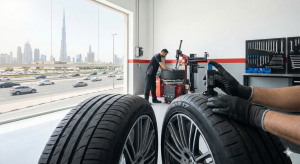
The Five-Year Rule First, there is the strict age limit. In the UAE, any tire older than five years from its manufacturing date is illegal to use on the road. This rule applies regardless of how much tread is left or how good the tire looks. You can find this date stamped on the sidewall of every tire in a four-digit code; for example, “3521” means the tire was manufactured in the 35th week of 2021. If your tires have expired, no amount of arguing will change the inspector’s mind.

Heat Damage and Dry Rot Second, inspectors look for “dry rot” or micro-cracks. The Sharjah heat is unforgiving to rubber compounds. Even if your tires are only three years old, if they have been parked in the direct sun daily, the rubber may have dried out and cracked between the treads or on the sidewall. These cracks indicate that the structural integrity of the tire is compromised, creating a high risk of a blowout at highway speeds.

Matching and Specification Third, they check for consistency. You cannot mix different tire brands, sizes, or tread patterns on the same axle. For instance, your front left and front right tires must be identical. If you had a flat tire six months ago and replaced just one with a cheaper brand, you will fail the test. The inspectors also check for wheel damage; a bent rim that causes vibration is a safety hazard. Ensuring your tires are fresh, matched, and in good condition is one of the easiest ways to guarantee a pass.

3. The Brake Efficiency and Imbalance Test

Once the visual check is done, the inspector drives your car onto the testing lane. This is where the machinery takes over, testing mechanical performance that human eyes cannot see. The brake test is arguably the most critical part of this safety check.

Understanding Brake Imbalance Your car is placed on rollers that spin the wheels while the inspector applies the brakes. The computer measures two distinct things: efficiency (total stopping power) and imbalance (the difference in force between the left and right wheels). Brake imbalance is a “silent killer” of passing results. You might feel your car stops fine in city traffic, but if the right caliper is applying 30% less force than the left caliper, the car will pull violently to one side during an emergency stop.

Causes of Failure This imbalance is often caused by a sticking caliper piston or uneven wear on the brake pads. In the dusty environment of the industrial areas, sand and grit can accumulate in the caliper slides, causing them to seize up. When this happens, the brake pad doesn’t make full contact with the rotor. Regular brake servicing, which involves cleaning and greasing these slides rather than just swapping pads, prevents this issue completely. Additionally, if your brake discs (rotors) are warped, the machine will detect the fluctuation in braking force, leading to a fail. At Smart Garage, we can resurface or replace rotors to ensure smooth, even braking.

4. Suspension and Steering Play

After the brake test, the car is put on a “shaker plate.” This machine violently shakes the car’s suspension side-to-side to simulate rough road conditions. The inspector stands underneath in a pit, using a torch to look for movement in the bushings, ball joints, and tie rod ends.

The Impact of UAE Roads While UAE roads are generally excellent, speed bumps and the occasional rough patch in industrial zones take a toll on suspension components. Rubber suspension bushings have a hard life here; the extreme ambient heat causes the rubber to become brittle and crack prematurely. Once a bushing cracks, the metal arm it holds starts to wobble. This creates “play” or looseness in the steering.

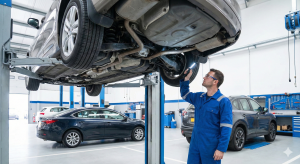
Why It Matters If you have noticed a clunking sound when you go over speed bumps, or if your steering wheel feels “loose” or vibrates at high speeds, you likely have worn suspension components. The testing center has zero tolerance for this because a failed ball joint can cause a wheel to collapse while driving, leading to a catastrophic accident. Inspecting the undercarriage is difficult for an owner to do at home without a lift, which is why a professional pre-inspection is vital. We check every control arm, link rod, and bush to ensure everything is tight and secure.

5. Environmental Standards and Fluid Leaks

The final hurdle is the environmental check. The UAE is committed to reducing pollution and maintaining clean roads, so your car must adhere to strict hygiene and emission standards.

Emissions and Engine Health If you drive a petrol car and it fails on emissions, it usually indicates that the engine is not burning fuel efficiently. This could be due to old spark plugs, a clogged air filter, or a failing oxygen sensor. For diesel vehicles, black smoke is the enemy. It signals unburnt fuel, usually caused by dirty injectors or a blocked EGR valve. Often, a “Italian Tune-up”—driving the car at higher RPMs on the highway for 20 minutes before the test—can heat up the catalytic converter enough to burn off deposits and help you pass, but this is only a temporary fix. The real solution is proper engine tuning and maintenance.

The “No Leak” Policy When the inspector is under your car, they are not just looking for suspension play; they are looking for fluids. A car that drips oil is considered a safety hazard to other motorists (as oil makes roads slippery) and a fire risk. There is a common misconception that older cars are “allowed” to leak a little. This is false. While a slight “sweating” or dampness around a gasket might be ignored depending on the inspector, any formation of droplets is an automatic fail.

If your engine or transmission is covered in old oil and grime, the inspector cannot see the source of the leak, and they may fail you just to be safe. We often recommend an engine degreasing and undercarriage wash before the test. This allows the inspector to see that the car is well-maintained and makes it easier to distinguish between old residue and an active leak.
Conclusion: The Smart Way to Pass

The difference between a stressful inspection day and a smooth one is preparation. Relying on luck is not a strategy. The most efficient way to handle your registration renewal is to treat it as a scheduled maintenance event rather than an administrative hurdle.

At Smart Garage, we offer a comprehensive “Pre-Passing Inspection” service designed to mimic the official RTA and Tasjeel tests. We put your car on the lift, check the lights, measure the emissions, and inspect the tires just like the inspectors do. By finding and fixing these small issues—a loose bulb, a worn bush, or a dirty filter—before you go to the testing center, we save you the cost of a re-test and the frustration of a wasted day.

Don’t gamble with your registration. Bring your vehicle to the experts in Industrial Area 6 and drive into your test with confidence.

 Failed Your Tasjeel Test? 5 Common Reasons Cars Fail in Sharjah

Failed Your Tasjeel Test? 5 Common Reasons Cars Fail in Sharjah

For every car owner in the United Arab Emirates, there is one specific date on the calendar that brings a unique mix of anxiety and dread. It isn’t a birthday, an anniversary, or a holiday. It is the expiration date on your vehicle registration card, commonly known as the Mulkiya.

Driving in the UAE is a pleasure, with wide highways and well-maintained roads connecting Sharjah, Dubai, and the Northern Emirates. However, the price of this safety is a rigorous annual inspection process. Whether you go to Tasjeel, Adnoc, or Shamil testing centers, the goal is the same: to ensure that every vehicle on the road is safe, roadworthy, and environmentally friendly. While the intention behind these tests is noble, the reality for many drivers is a frustrating cycle of rejection. You drive to the center, wait in a long queue, pay the inspection fee, and hand your keys to the inspector. Fifteen minutes later, you are handed a certificate stamped in red: FAILED.

Suddenly, your afternoon is ruined. You are now on a clock. You have roughly 30 days to fix the issues and return for a re-test. If you fail again, you pay again. If you delay too long, you face fines for driving with an expired registration. It is a costly, time-consuming hassle that most people dread.

At Smart Garage, located in the heart of Sharjah’s Industrial Area 6, we believe that this annual stress is unnecessary. After servicing thousands of vehicles for their annual passing, we have learned that failure is rarely a surprise it is almost always predictable. By understanding exactly what the inspectors are looking for, you can save yourself the embarrassment of a failed test and the cost of a re-inspection. This guide will take you through the technical, visual, and mechanical intricacies of the UAE vehicle testing process, helping you ensure your car passes with flying colors on the first try.

1. The Visual Inspection: More Than Just Looks

The most frustrating failures are the ones you could have seen with your own eyes before leaving your house. A significant portion of vehicles fail simply because of visual defects that the owner ignored or didn’t notice. The inspectors start forming an opinion of your car the moment they see it, and visible neglect often leads to a more rigorous inspection of the mechanical components.

The Complexity of Lighting Systems Lighting is the most common reason for immediate failure. It is not enough for your headlights to simply turn on. The inspectors are checking for beam alignment, intensity, and clarity. Over time, the plastic lenses of your headlights can oxidize and turn yellow due to the intense UAE sun and UV exposure. If this “hazing” restricts the light output or scatters the beam, you will fail, even if the bulb inside is brand new and functioning perfectly.

Furthermore, many drivers in Sharjah modify their vehicles with aftermarket LED or HID kits to improve visibility on dark roads. While these might look modern, if they are not properly calibrated or if they blind oncoming traffic, they are grounds for immediate rejection. The most overlooked lights, however, are the small ones: the license plate bulbs, the reverse lights, and the high-mount third brake light. It is incredibly easy to miss a burnt-out brake light because you are sitting inside the car when you press the pedal. We always recommend parking in front of a glass storefront or a wall at night to check the reflection of your lights before heading to the testing center.

Bodywork, Chassis, and Aesthetics There is a major difference between a cosmetic dent and structural damage. You can usually pass with a small dent or scratch on the bumper or door panel, provided it doesn’t have sharp edges that could injure a pedestrian. However, any damage to the vehicle’s main structure—the chassis rails or pillars—is a major safety violation that will take your car off the road immediately.

Similarly, the condition of your paint matters more than you might think. If your car has a “matte” paint job that isn’t registered on the card, or if the paint is peeling significantly, inspectors may flag it. Stickers and decals are another point of contention. Unless you have a permit for commercial advertising, large stickers that obscure vision or change the vehicle’s appearance can lead to a fail. Even window tinting, which is essential in our climate, has strict legal limits. If you bought a used car with very dark tint, or if your tint has started to bubble and peel, obstructing your view of the side mirrors, you will be asked to remove it on the spot. Scraping off old tint in the parking lot of a testing center is a miserable experience; it is far better to have it professionally replaced at Smart Garage before you go.

2. Tires and Wheels: The Absolute Zero Tolerance Policy

Tires are the single most critical safety component on your vehicle, as they are the only contact point between your car and the road. Consequently, the regulations regarding them are absolute and non-negotiable.

The Five-Year Rule First, there is the strict age limit. In the UAE, any tire older than five years from its manufacturing date is illegal to use on the road. This rule applies regardless of how much tread is left or how good the tire looks. You can find this date stamped on the sidewall of every tire in a four-digit code; for example, “3521” means the tire was manufactured in the 35th week of 2021. If your tires have expired, no amount of arguing will change the inspector’s mind.

Heat Damage and Dry Rot Second, inspectors look for “dry rot” or micro-cracks. The Sharjah heat is unforgiving to rubber compounds. Even if your tires are only three years old, if they have been parked in the direct sun daily, the rubber may have dried out and cracked between the treads or on the sidewall. These cracks indicate that the structural integrity of the tire is compromised, creating a high risk of a blowout at highway speeds.

Matching and Specification Third, they check for consistency. You cannot mix different tire brands, sizes, or tread patterns on the same axle. For instance, your front left and front right tires must be identical. If you had a flat tire six months ago and replaced just one with a cheaper brand, you will fail the test. The inspectors also check for wheel damage; a bent rim that causes vibration is a safety hazard. Ensuring your tires are fresh, matched, and in good condition is one of the easiest ways to guarantee a pass.

3. The Brake Efficiency and Imbalance Test

Once the visual check is done, the inspector drives your car onto the testing lane. This is where the machinery takes over, testing mechanical performance that human eyes cannot see. The brake test is arguably the most critical part of this safety check.

Understanding Brake Imbalance Your car is placed on rollers that spin the wheels while the inspector applies the brakes. The computer measures two distinct things: efficiency (total stopping power) and imbalance (the difference in force between the left and right wheels). Brake imbalance is a “silent killer” of passing results. You might feel your car stops fine in city traffic, but if the right caliper is applying 30% less force than the left caliper, the car will pull violently to one side during an emergency stop.

Causes of Failure This imbalance is often caused by a sticking caliper piston or uneven wear on the brake pads. In the dusty environment of the industrial areas, sand and grit can accumulate in the caliper slides, causing them to seize up. When this happens, the brake pad doesn’t make full contact with the rotor. Regular brake servicing, which involves cleaning and greasing these slides rather than just swapping pads, prevents this issue completely. Additionally, if your brake discs (rotors) are warped, the machine will detect the fluctuation in braking force, leading to a fail. At Smart Garage, we can resurface or replace rotors to ensure smooth, even braking.

4. Suspension and Steering Play

After the brake test, the car is put on a “shaker plate.” This machine violently shakes the car’s suspension side-to-side to simulate rough road conditions. The inspector stands underneath in a pit, using a torch to look for movement in the bushings, ball joints, and tie rod ends.

The Impact of UAE Roads While UAE roads are generally excellent, speed bumps and the occasional rough patch in industrial zones take a toll on suspension components. Rubber suspension bushings have a hard life here; the extreme ambient heat causes the rubber to become brittle and crack prematurely. Once a bushing cracks, the metal arm it holds starts to wobble. This creates “play” or looseness in the steering.

Why It Matters If you have noticed a clunking sound when you go over speed bumps, or if your steering wheel feels “loose” or vibrates at high speeds, you likely have worn suspension components. The testing center has zero tolerance for this because a failed ball joint can cause a wheel to collapse while driving, leading to a catastrophic accident. Inspecting the undercarriage is difficult for an owner to do at home without a lift, which is why a professional pre-inspection is vital. We check every control arm, link rod, and bush to ensure everything is tight and secure.

5. Environmental Standards and Fluid Leaks

The final hurdle is the environmental check. The UAE is committed to reducing pollution and maintaining clean roads, so your car must adhere to strict hygiene and emission standards.

Emissions and Engine Health If you drive a petrol car and it fails on emissions, it usually indicates that the engine is not burning fuel efficiently. This could be due to old spark plugs, a clogged air filter, or a failing oxygen sensor. For diesel vehicles, black smoke is the enemy. It signals unburnt fuel, usually caused by dirty injectors or a blocked EGR valve. Often, a “Italian Tune-up”—driving the car at higher RPMs on the highway for 20 minutes before the test—can heat up the catalytic converter enough to burn off deposits and help you pass, but this is only a temporary fix. The real solution is proper engine tuning and maintenance.

The “No Leak” Policy When the inspector is under your car, they are not just looking for suspension play; they are looking for fluids. A car that drips oil is considered a safety hazard to other motorists (as oil makes roads slippery) and a fire risk. There is a common misconception that older cars are “allowed” to leak a little. This is false. While a slight “sweating” or dampness around a gasket might be ignored depending on the inspector, any formation of droplets is an automatic fail.

If your engine or transmission is covered in old oil and grime, the inspector cannot see the source of the leak, and they may fail you just to be safe. We often recommend an engine degreasing and undercarriage wash before the test. This allows the inspector to see that the car is well-maintained and makes it easier to distinguish between old residue and an active leak.

Conclusion: The Smart Way to Pass

The difference between a stressful inspection day and a smooth one is preparation. Relying on luck is not a strategy. The most efficient way to handle your registration renewal is to treat it as a scheduled maintenance event rather than an administrative hurdle.

At Smart Garage, we offer a comprehensive “Pre-Passing Inspection” service designed to mimic the official RTA and Tasjeel tests. We put your car on the lift, check the lights, measure the emissions, and inspect the tires just like the inspectors do. By finding and fixing these small issues—a loose bulb, a worn bush, or a dirty filter—before you go to the testing center, we save you the cost of a re-test and the frustration of a wasted day.

Don’t gamble with your registration. Bring your vehicle to the experts in Industrial Area 6 and drive into your test with confidence.

Leave a Reply

Your email address will not be published. Required fields are marked *

Smart Garage
Service Advisor
Online
Smart Garage
Hello! How can we help you with your car today? 👋
Just now
1