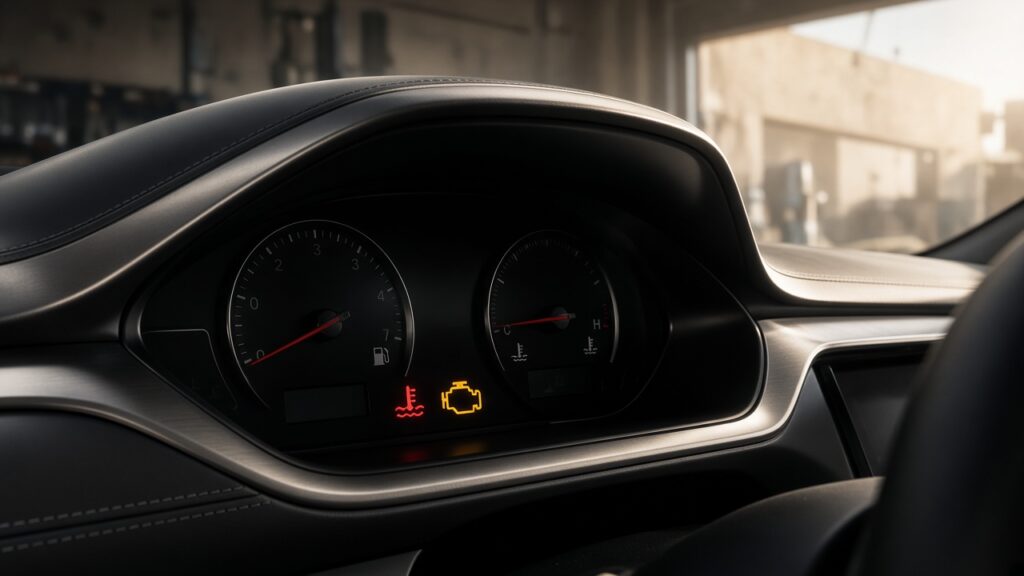
Picture this: It is mid-July in Dubai. The ambient temperature is hovering around 45°C, and the road surface is baking at nearly 65°C. You are cruising down Sheikh Zayed Road, the AC is fighting a valiant battle against the heat, and suddenly—silence. The music stops, the dashboard lights up like a festive tree, and your engine shudders to a halt. You haven’t just suffered a mechanical breakdown; you are the latest casualty of the silent war between modern automotive technology and the unforgiving UAE climate.
In the past, a car was a mechanical beast. If it broke, you grabbed a wrench. Today, your vehicle is a rolling supercomputer, a sophisticated network of over 100 Electronic Control Units (ECUs) talking to each other in a language of millisecond pulses. In the unique environment of the Emirates, where fine silica dust meets extreme humidity and scorching heat, the integrity of this electrical nervous system is constantly under siege. A single corroded connector or a heat-soaked sensor can leave you stranded, or worse, cause a catastrophic fire.
This is where the game changes. To truly protect your investment and ensure your safety, you cannot rely on simple “code reading” or guesswork. You require Advanced car Diagnostics & Electrical Services, a disciplined, forensic approach to vehicle health that goes far beyond what a standard mechanic can offer. At Smart Garage, we don’t just swap parts; we interpret the digital heartbeat of your machine to prevent failures before they happen.
The Thermodynamics of Failure: Why UAE Electronics Suffer
To understand why electrical systems fail so frequently in our region, we must look at the physics of the engine bay. In temperate climates, electrical resistance within your car’s wiring remains relatively stable. However, in the UAE, vehicles undergo extreme “thermal cycling.” Every time you drive, the copper wiring heats up and expands; when you park in an air-conditioned basement, it cools and contracts.
Over thousands of these cycles, the insulation on the wires becomes brittle and cracks. This allows moisture and conductive desert dust to penetrate the harness. According to fundamental laws of electricity, as heat increases, resistance increases. This means your alternator has to work significantly harder to push current through hot, resistant wires to reach your fuel injectors and ignition coils. This added strain is the primary reason why a battery that lasts five years in Europe may only survive 12 to 18 months in Sharjah or Dubai.
The Dust Factor: The Enemy of Connectivity
It is not just the heat. The fine sand found in the UAE is microscopic and abrasive. It works its way past weather seals and into electrical connectors. When humidity rises often hitting 90% in coastal cities this dust turns into a conductive sludge that bridges the tiny gap between pins in a connector. This creates “ghost faults,” where a sensor is working perfectly, but the signal reaching the computer is corrupted.
Beyond the Code Reader: The Truth About “Free Scans”
Walk into many quick-service centers in Al Quoz or Mussafah, and you will see signs offering a “Free Computer Scan.” It sounds appealing, but it is often a trap. These scans typically use generic OBD-II readers that can only access “Global OBD” data. They might give you a code like P0300 (Random Misfire), but they cannot tell you why the misfire occurred.
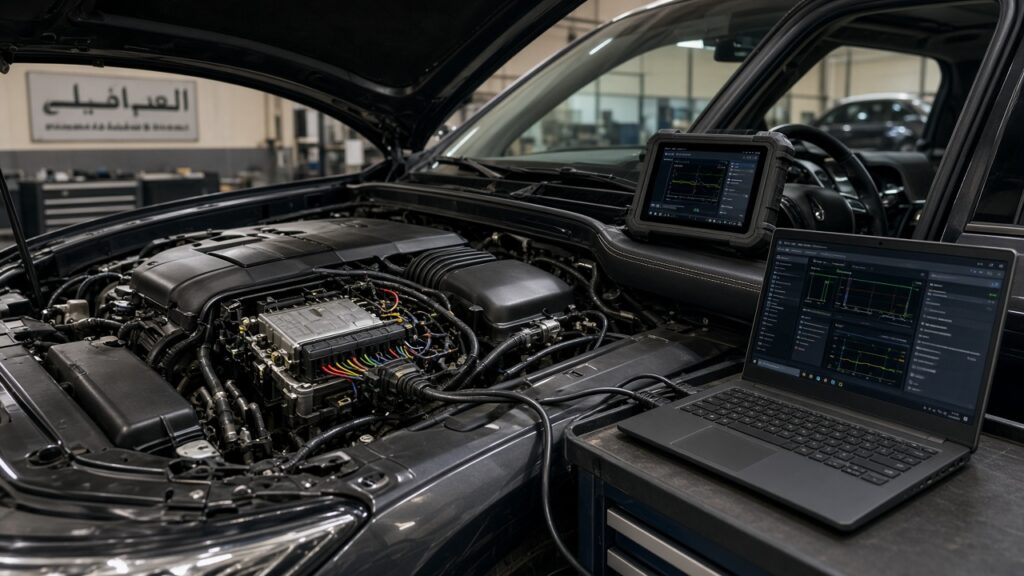
At Smart Garage, we operate at Level 4 Diagnostics. This involves three critical steps that separate a true diagnostic expert from a parts changer:
-
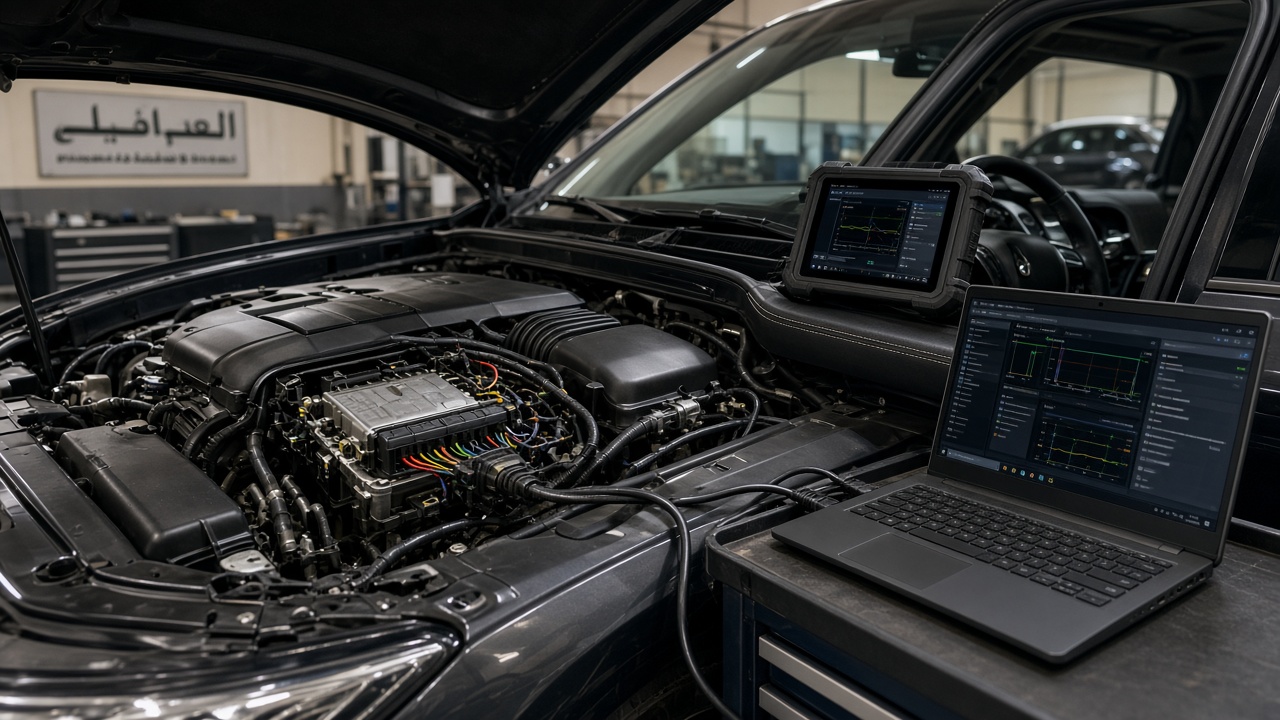
Topology Mapping: We don’t just look at the engine; we map the entire “CAN Bus” network. This is the communication highway that connects your transmission, ABS, airbags, and body control modules. If a door module is crashing the network, a generic scanner won’t see it—but our topology map will show a “communication break” in red.
-
Freeze Frame Analysis: When a fault code is triggered, the car’s computer takes a snapshot of the sensor data at that exact millisecond. We analyze this data to see the context. Was the engine cold? Was the car moving at 120 km/h? This context is key to replication.
-
Oscilloscope Testing: This is our secret weapon. A multimeter shows the average voltage, which is useless for signals that happen 1,000 times a second. An oscilloscope draws a line graph of electricity over time. We can see the “shape” of the signal. A jagged line on a fuel injector pulse tells us the solenoid is sticking mechanically, something a computer code will never tell you.
Model-Specific Case Studies: The UAE Big Three
Our years of experience in the UAE have allowed us to identify specific electrical patterns in the region’s most popular vehicles.
1. Nissan Patrol (Y62): The “Smart” Charging Paradox
The Nissan Patrol is the King of the Desert, but its electrical system has a known quirk: the Smart Charging System. To save fuel, the Y62’s ECU is programmed to stop charging the battery when the car is accelerating, only engaging the alternator when you coast or brake.
The Problem: In the UAE summer, with front and rear AC blasting and perhaps a fridge running in the back, the electrical load is massive. The “Smart” system sometimes reacts too slowly, letting the battery voltage drop dangerously low. The Smart Garage Fix: We check the “IPDM” (Intelligent Power Distribution Module) and the current sensor on the battery negative terminal. In many cases, we can perform a software calibration to force a more aggressive charging profile that suits the UAE climate better than the global standard.
2. Toyota Land Cruiser: The Grounding Issue
Land Cruisers are built like tanks, but they are often modified with light bars, winches, and high-end audio systems. The Problem: We frequently see “Christmas Tree” dashboards (where every warning light turns on) on Land Cruisers. This is rarely a computer failure. It is usually a “ground loop” issue caused by aftermarket accessories sharing a poor ground point. The Smart Garage Fix: We perform a “Voltage Drop Test” on the chassis ground straps. If we find more than 0.5 volts of resistance, we install upgraded, heavy-duty grounding cables that can handle the extra electrical load, instantly clearing the dashboard errors.
3. German Luxury (BMW & Mercedes): Coding vs. Programming
German cars rely heavily on precise sensor data. A common issue we see is with the “Intelligent Battery Sensor” (IBS). The Problem: When you replace a battery in a BMW or Mercedes, you cannot simply drop it in. The car’s computer tracks the age of the battery and adjusts the charging rate accordingly. If you put a new battery in without “registering” it, the alternator will treat it like the old, dying battery, overcharging it and destroying it in weeks. The Smart Garage Fix: We use OEM-level software (ISTA for BMW, Xentry for Mercedes) to “code” the new battery to the car. We also distinguish between Coding (changing settings, like enabling folding mirrors) and Programming (updating the operating system of a module). We ensure your car’s software is up to date, which can often fix driveability issues without turning a single wrench.
The Vampire in Your Garage: Parasitic Battery Drain
There is nothing more frustrating than waking up to a dead car. If your battery tests “Good” and your alternator is charging, you have a Parasitic Drain.
Modern cars never truly sleep. They enter a low-power “standby” mode where they check for key fobs and listen for telematics updates. A healthy car should draw less than 50 milliamps (0.05 Amps) in sleep mode. We often see cars drawing 2 or 3 Amps continuously—enough to kill a battery overnight.
Common Culprits in Dubai:
-
Aftermarket Tracking Devices: Often installed by banks or insurance companies, these can malfunction in the heat and stay “awake,” constantly pinging the GPS network.
-
Comfort Access Handles: On luxury cars, the door handles have touch sensors. Moisture and humidity can short these sensors, making the car think you are constantly trying to open the door, keeping the main computer awake.
-
Glove Box Lights: It sounds simple, but a broken switch that keeps a tiny 5-watt bulb on inside your glove box is a silent killer of batteries.
How We Find It: We use a thermal imaging camera to look at the fuse box. A circuit that is drawing power generates heat. The fuse carrying the parasitic current will glow slightly warmer than the others in the thermal image, allowing us to pinpoint the circuit without pulling fuses and resetting the computer.
Preparing for the Future: RTA Testing 2025
The Roads and Transport Authority (RTA) is continuously upgrading its testing standards to align with Dubai’s vision of a smart city. The upcoming 2025 testing protocols are expected to be stricter than ever regarding electronic roadworthiness.
OBD Readiness Monitors: In the past, people would disconnect their battery to clear a “Check Engine” light just before the test. This will no longer work. The new RTA systems check for “Readiness Monitors.” These are self-tests the car runs on its catalytic converter and emissions system. If you clear the codes, the monitors reset to “Not Ready.” If your monitors are not ready, you will fail the test automatically, even if the check engine light is off.
EV & Hybrid Safety: For the growing number of Tesla and Hybrid owners, RTA 2025 protocols include “State of Health” checks for the high-voltage battery and inspection of the orange high-voltage cabling. A frayed cable is a safety hazard that will result in an instant fail. Our technicians are High-Voltage Certified to inspect and repair these systems safely.
Actionable Tips: The Smart Garage Maintenance Checklist
To keep your car’s electrical system healthy, follow these expert tips:
-
The “Summer Prep” Load Test: Don’t just check the voltage. Ask for a “Carbon Pile Load Test.” This simulates the stress of starting the engine. A battery can show 12 Volts but collapse to 0 Volts under load.
-
Clean Your Drains: It sounds unrelated, but clogged sunroof drains can cause water to overflow into the cabin, often pooling exactly where the body control module is located (under the carpet). We have saved many cars by simply cleaning these rubber tubes.
-
Respect the “Sleep”: If you are going on a summer vacation, do not just leave the car. Connect a “Smart Charger” or “Trickle Charger.” If you must disconnect the battery, be aware that you might lose memory settings (seat positions, radio stations) and your throttle body might need a “re-learn” procedure when you reconnect it.
-
Watch for the Flicker: If you notice your headlights pulsing or your dashboard lights flickering at night, do not ignore it. This is often the first sign of an “AC Ripple” failure in the alternator, where alternating current leaks into the DC system. This “dirty electricity” can fry sensitive computers if left unchecked.
Conclusion: Don’t Guess, Test.
The era of the “grease monkey” is over. The modern automotive technician is a data analyst, a chemist, and an electrical engineer rolled into one. In the United Arab Emirates, where the environment wages a constant war against your vehicle’s delicate electronics, the quality of your maintenance partner defines your ownership experience.
At Smart Garage, we believe in evidence-based repair. We don’t just tell you what is wrong; we show you the data, the waveforms, and the thermal images. Whether you drive a rugged Nissan Patrol conquering the dunes or a sophisticated Mercedes S-Class cruising the city, our advanced diagnostic capabilities ensure that your journey remains uninterrupted.
Is your car showing the early warning signs? A sluggish start, a flickering light, or a mysterious hesitation? Don’t wait for the breakdown.Contact our team and give your car the expert care it deserves.