Have you ever pressed your brake pedal only to feel a terrifying “sink” or a soft, spongy response instead of a crisp, immediate stop? Most drivers in the UAE focus on their engine oil or tire pressure, yet they overlook the one liquid that literally stands between them and a collision: brake fluid. If you’ve been searching for a brake fluid flush service near me, you aren’t just looking for a maintenance task you are looking to restore the lifeblood of your vehicle’s safety system.
In this deep dive, we explore why a brake fluid flush is non-negotiable for desert driving, the science of “hygroscopic” liquids, and how to ensure your vehicle remains a fortress of safety on the busy roads of Sharjah and Dubai.
1. The Hidden Danger: Understanding Brake Fluid Degradation
Brake fluid is a hydraulic fluid that operates under intense pressure and high temperatures. Unlike engine oil, which lubricates, brake fluid is designed to be incompressible, allowing the force of your foot to move the heavy brake calipers.
However, brake fluid is hygroscopic. This means it actively absorbs moisture from the air. Even in the arid climate of the UAE, humidity levels can spike, and the cooling-heating cycles of your engine bay create condensation.
What happens when water enters the system?
-
Lowered Boiling Point: Pure brake fluid (DOT 4) boils at around 230°C. If just 3% water is introduced, that boiling point drops significantly. During heavy braking in 45°C heat, the water turns to steam. Since steam is compressible, your brakes “fade” or fail.
-
Internal Corrosion: Water leads to rust. This rust eats away at your expensive ABS (Anti-lock Braking System) pumps and master cylinders from the inside out.
2. Top Signs You Need a Brake Fluid Flush Service Near Me
Don’t wait for a warning light. Your car provides several sensory clues that the hydraulic integrity is compromised:
-
The Spongy Pedal: If you have to pump the brakes or push the pedal further than usual to stop, there is likely air or water vapor in the lines.
-
Discolored Fluid: Healthy brake fluid is clear or slightly amber. If it looks like dark tea, cola, or has visible particles, it is saturated with moisture and debris.
-
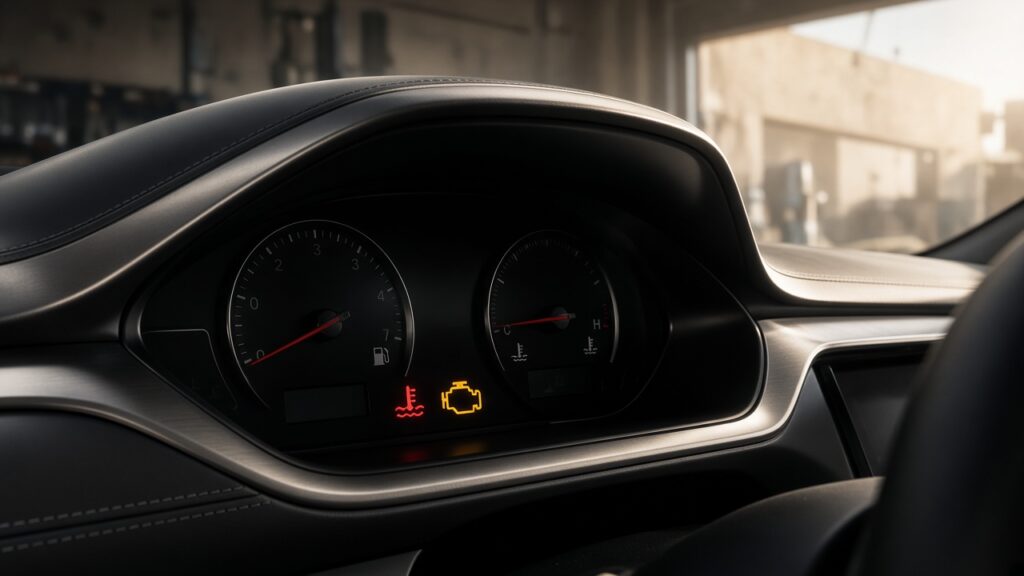
ABS Warning Light: Modern sensors can detect pressure irregularities. An illuminated ABS light is often the first electronic signal that your fluid is failing.
- A Strange Smell: After a long drive or downhill descent, a burning chemical smell indicates the fluid is overheating and breaking down.
For a professional diagnosis, a brake system repair and maintenance specialist can test the moisture content using digital refractometers.
3. UAE Climate: A Silent Killer of Brake Hydraulics
Living in Sharjah or Dubai presents a unique set of challenges. We often think the desert is “dry,” but the coastal humidity combined with extreme thermal stress accelerates fluid oxidation.
The “Heat Soak” Effect
When you park your car after a commute in the peak of summer, the heat under the hood continues to rise. This “heat soak” stresses the rubber seals in your braking system. As these seals expand and contract, microscopic amounts of moisture and dust find their way into the reservoir. A regular brake fluid flush service acts as a “reset button” for these components, flushing out contaminants before they cause a permanent mechanical failure.
4. DOT 3, DOT 4, or DOT 5.1? Choosing the Right Fluid
When you visit a service center, you’ll see different ratings. It is crucial to use what the manufacturer specifies.
- DOT 3: Common in older vehicles; has the lowest boiling point.
- DOT 4: The standard for most modern European and Japanese cars. It has a higher boiling point and better additives to handle heat.
- DOT 5.1: High-performance fluid with a very high boiling point, often used in heavy SUVs or performance cars that frequent the highways.
Note: Never mix silicone-based DOT 5 with glycol-based DOT 3 or 4, as it will lead to immediate system failure.
5. The Professional Flush Process vs. A Simple Bleed
Many “quick-lube” shops offer a “brake bleed,” but this is not a full flush. Here is the E-E-A-T standard process you should expect from a reputable garage:
-
Reservoir Extraction: The old, contaminated fluid is vacuumed out of the master cylinder reservoir.
-
Pressure Flushing: A specialized machine attaches to the reservoir, forcing fresh, pressurized fluid through the entire system.
-
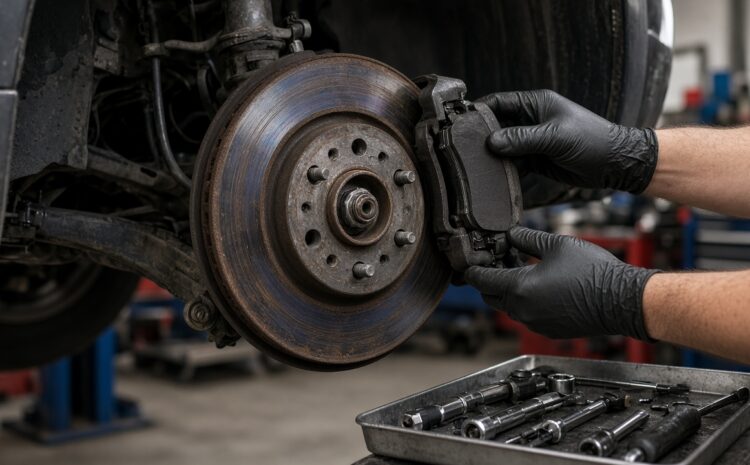
Four-Corner Sequence: The technician opens the bleeder valves at each wheel (starting furthest from the master cylinder) until the fluid running out is 100% clear and bubble-free.
-
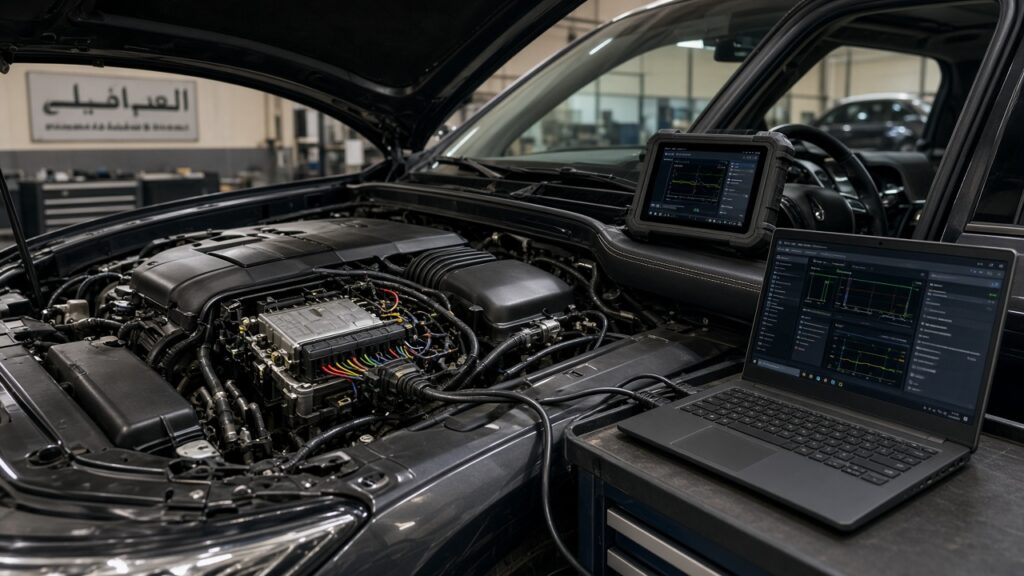
ABS Cycling: On modern vehicles, an OBD-II scanner is used to cycle the ABS valves to ensure old fluid trapped in the pump is also replaced.
6. Actionable Maintenance Tips for Drivers
To keep your braking system in top shape between services, follow these expert recommendations:
-
Keep the Cap Tight: Never leave your brake fluid reservoir cap off for longer than necessary. Even ten minutes of exposure to humid air can degrade the fluid.
-
Check Every Oil Change: Ask your technician to perform a “strip test” or use a moisture pen during every engine oil service.
-
Intervals: In the UAE, we recommend a full flush every 2 years or 40,000 kilometers, whichever comes first.
-
Don’t DIY without Knowledge: Modern cars require specific sequences to avoid damaging the ABS module. If air gets trapped in the ABS pump, it often requires a professional scan tool to remove.
7. Real-World Application: The “Saved by the Flush” Story
I remember a client who drove a heavy SUV between Sharjah and Abu Dhabi daily. He complained that his brakes felt “fine” most of the time but “weird” during high-speed stops. Upon inspection, his fluid was nearly 4% water. We performed a full flush with high-temp DOT 4. Two weeks later, he had to slam his brakes on the E11 to avoid a sudden pile-up. He called us to say the pedal felt firm and the car stopped meters short of the accident. That $50 maintenance task likely saved his vehicle and his health.
9. Conclusion: Don’t Gamble with Your Stopping Distance
A brake fluid flush service near me is one of the most undervalued yet critical maintenance tasks you can perform. By removing moisture, air, and debris, you are protecting your car’s most expensive safety components and ensuring that when you hit the brakes, the car responds exactly as it should.
Key Takeaways:
- Brake fluid absorbs water, which can cause total brake failure in high heat.
- A “spongy” pedal is a major red flag.
- The UAE climate requires more frequent fluid changes (every 2 years).