Home About Services Brands Blog Contact
May 23, 2026 • Engine Services

Volkswagen DSG Jerking and Shuddering What’s Really Going On?

Volkswagen’s Direct-Shift Gearbox (DSG) revolutionized the automotive world by combining the fuel economy of a manual transmission with the ease of an automatic. When working perfectly, it delivers lightning-fast, seamless gear changes. However, if you are driving through the stop-and-go traffic of Dubai or Sharjah and suddenly feel your car jolting, you are likely experiencing the notorious Volkswagen DSG jerking and shuddering phenomenon.

When a premium transmission starts misbehaving, it can be deeply frustrating. What starts as a minor vibration when pulling away from a stoplight can quickly escalate into harsh gear drops, scary hesitations at intersections, or the dreaded dashboard warning lights.

If your VW is no longer shifting smoothly, you are probably wondering: Is this a simple software glitch, or am I looking at a catastrophic mechanical failure? Let’s dive deep into what is actually happening inside your transmission and how we handle these issues at Smart Garage.

Decoding the Volkswagen Dual-Clutch Architecture: Why System Vulnerability Leads to Mechanical Shuddering

To truly understand why your vehicle is shaking, vibrating, or lunging forward unexpectedly, it helps to break down how the DSG functions under the hood. Unlike a traditional automatic transmission that relies on a fluid-driven torque converter to cushion and smooth out gear transitions, a DSG is essentially an automated manual transmission. It utilizes two independent, co-axial clutch packs—one handling the odd gears ($1, 3, 5, 7$) and the other managing the even gears ($2, 4, 6, R$). While your car is actively accelerating in third gear, the transmission’s computer has already pre-selected fourth gear on the secondary shaft, waiting to swap the clutches in a fraction of a second.

Because the DSG system relies on direct, mechanical friction engagement rather than a fluid cushion, any small irregularity in hydraulic line pressure, mechanical friction wear, or electronic sensor data becomes instantly noticeable to the driver. The transmission lacks a built-in way to hide its flaws; when a component struggles, you will feel it right through your seat. In the demanding climate of the UAE, where ambient temperatures climb drastically, these mechanical tolerances are pushed to their absolute limits, turning minor operational imbalances into prominent drivability issues.

Recognizing the Warning Signs: Primary Symptoms of Volkswagen DSG Jerking and Shuddering

DSG gearbox problems rarely stay small for long. Recognizing the symptoms early can mean the difference between a minor calibration service and an incredibly expensive total gearbox replacement. Drivers typically report a handful of distinct failure behaviors during their daily commutes:

  • Violent Shuddering from a Dead Stop: As you lift your foot off the brake pedal and apply the throttle, the car vibrates heavily across the front axle, mimicking a novice driver struggling to balance a manual clutch pedal.

  • Low-Speed Transmission Jerking in Heavy Traffic: Moving between first, second, and third gear in slow-moving traffic causes the vehicle to jolt, snap, or “snatch” aggressively into gear rather than rolling smoothly.

  • Delayed Drive Engagement Accompanied by a Loud “Bang”: When selecting Drive ($D$) or Reverse ($R$), there is a distinct two-to-three-second pause where nothing happens, followed by a sudden, harsh mechanical jolt as power is abruptly dumped into the drive wheels.

  • Shift Flares and Intermittent Power Loss: During acceleration, the engine RPMs may spike wildly between gear changes (flaring) as if the transmission is slipping, causing a sudden loss of forward momentum when you need it most.

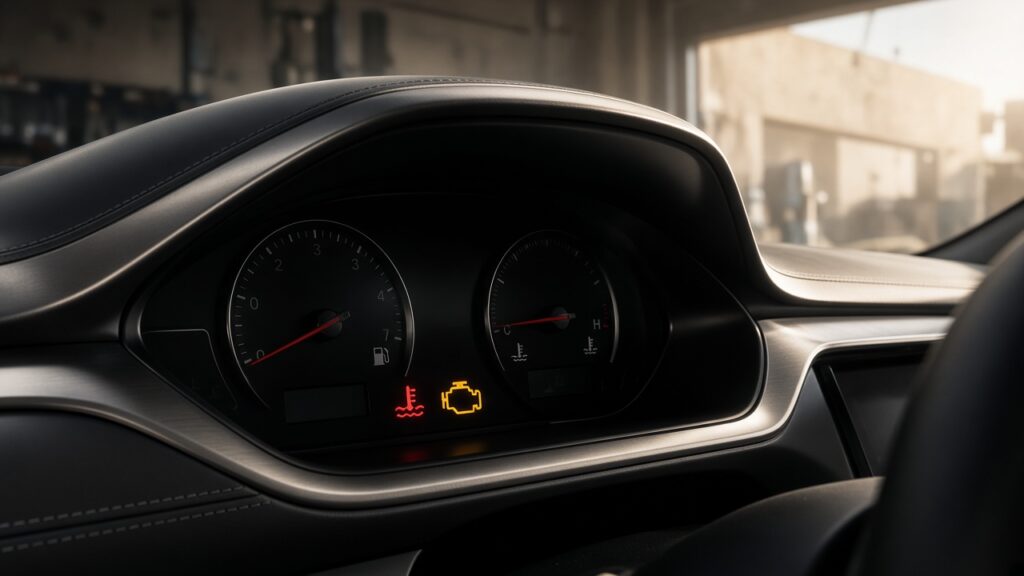
  • Random Drops into Neutral or Total Limp Mode: The transmission suddenly drops out of gear entirely while driving, or restricts you to a single gear while flashing a spanner icon or the PRNDS lights on your instrument cluster.

Investigating the Root Causes: Technical Analysis of Gearbox Component Failure

When your Volkswagen begins to jerk and shudder, the root cause almost always boils down to one of three main culprits: the dual-clutch packs, the complex mechatronic unit, or the internal fluid condition.

Worn Dual-Clutch Packs and Friction Degradation

Just like a standard manual car, the friction linings on a DSG’s dual-clutch packs wear down over time. This is especially true for dry-clutch setups (commonly found in smaller engine variants like the 1.4 TSI with the DQ200 gearbox) which lack oil cooling to dissipate heat.

Constant stop-and-go driving in high ambient temperatures causes intense thermal stress. As the friction material degrades, the transmission control unit struggles to calculate the exact “bite point” (or kiss-point) of the clutches. The resulting slippage manifests as a severe shudder, primarily when accelerating from a standstill or shifting between low gears.

Faulty Mechatronic Unit and Hydraulic System Malfunctions

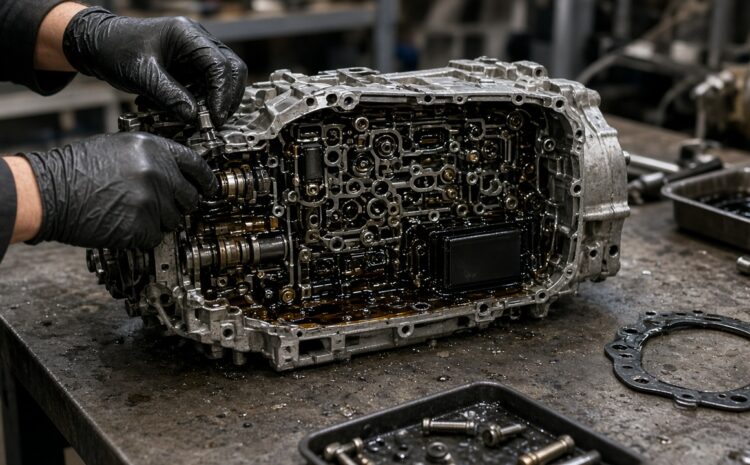
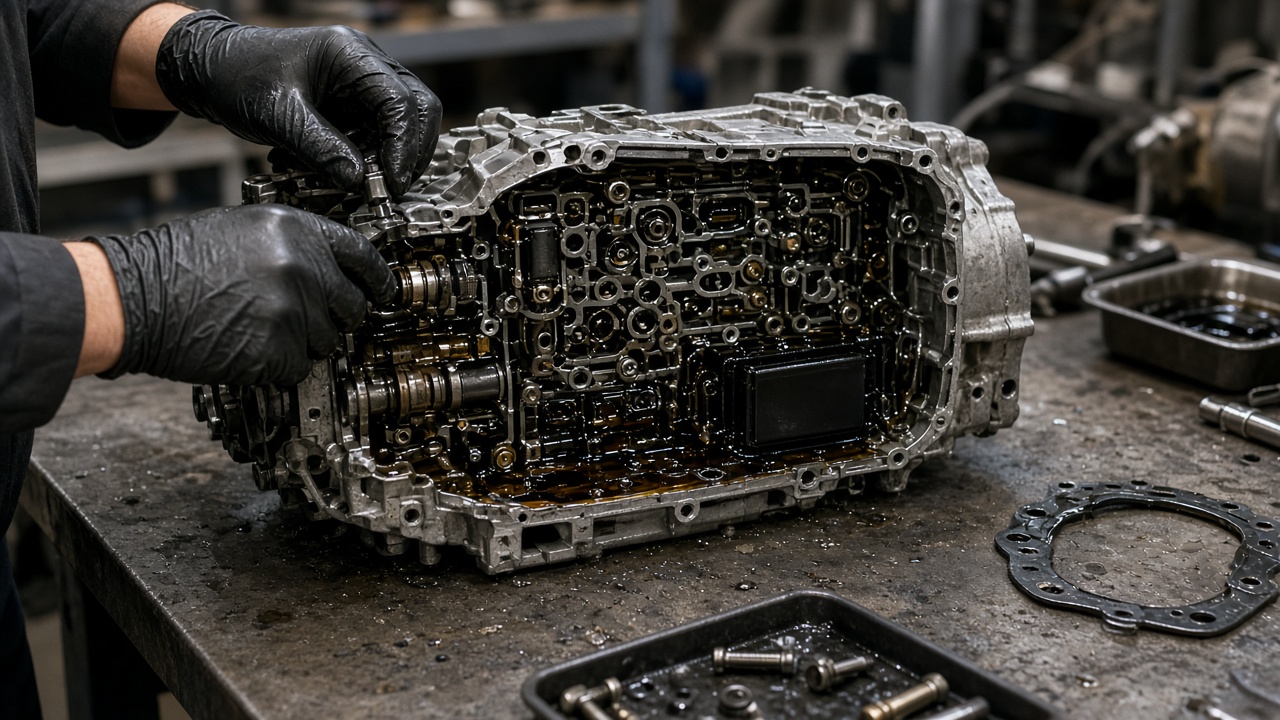
The mechatronic unit is the absolute command center of the transmission. It houses the Transmission Control Unit (TCU), an array of electronic sensors, and a complex hydraulic valve body utilizing solenoids to physically shift the gears and open the clutches.

If the mechatronic unit develops internal faults, the entire transmission loses its precision. Common failure points include:

  • Solenoid Valve Wear: Microscopic debris can cause the solenoids to stick, preventing fluid from flowing smoothly. This results in erratic, jerky shifting patterns.

  • Internal Pressure Loss: Cracks in the housing of the hydraulic accumulator or failed internal seals lead to a drop in system pressure. Without adequate hydraulic pressure, clutch engagement becomes slow, unpredictable, and violent.

  • Electronic Sensor Drift: If internal temperature or speed sensors begin sending inaccurate data to the TCU, the system applies protective, erratic behaviors that ruin drivability.

Fluid Contamination, Thermal Stress, and Sludge Accumulation

For wet-clutch DSG systems (such as the heavy-duty DQ250, DQ381, or DQ500 found in Golf GTIs, Rs, and Tiguans), the clutch packs operate completely submerged in specialized transmission oil. This fluid acts as both a coolant and a hydraulic medium.
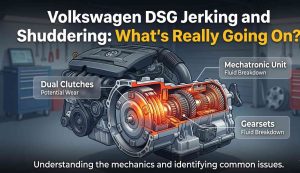
Over time, minute metallic particles worn off the clutches mix into the fluid. If the oil is not replaced at strict intervals, this contaminated fluid turns into an abrasive sludge that clogs the fine passages within the mechatronic unit and coats the speed sensors. The immediate result is a severe shudder when the transmission gets hot, paired with unrefined shifting.

The Risk of Delay: How Minor Transmission Jerking Escalates into Catastrophic Damage

A slightly jerky transmission today can easily transform into an undrivable vehicle next week. Ignoring these early warning signs sets off a damaging chain reaction inside the gearbox.

The Damage Chain Reaction: Continuous clutch slippage creates excessive localized heat. This intense heat rapidly degrades the remaining transmission oil and cooks the delicate electronic circuit boards inside the mechatronic unit. Furthermore, unstable torque delivery puts extreme structural stress on the dual-mass flywheel, eventually causing severe internal mechanical damage.

If your vehicle exhibits unpredictable drive engagement, it can also become a safety hazard, potentially leaving you stranded in the middle of a busy highway or unable to accelerate when merging into fast-moving traffic.

Advanced Gearbox Diagnosis: The Smart Garage Diagnostic Routine

Fixing a Volkswagen DSG requires specialized diagnostic equipment and deep mechanical expertise. At Smart Garage, we never rely on simple guesswork or basic code-reading. A proper repair requires a meticulous, systematic approach to locate the true root cause.

Comprehensive Software Diagnostics and Live Data Log Tracking

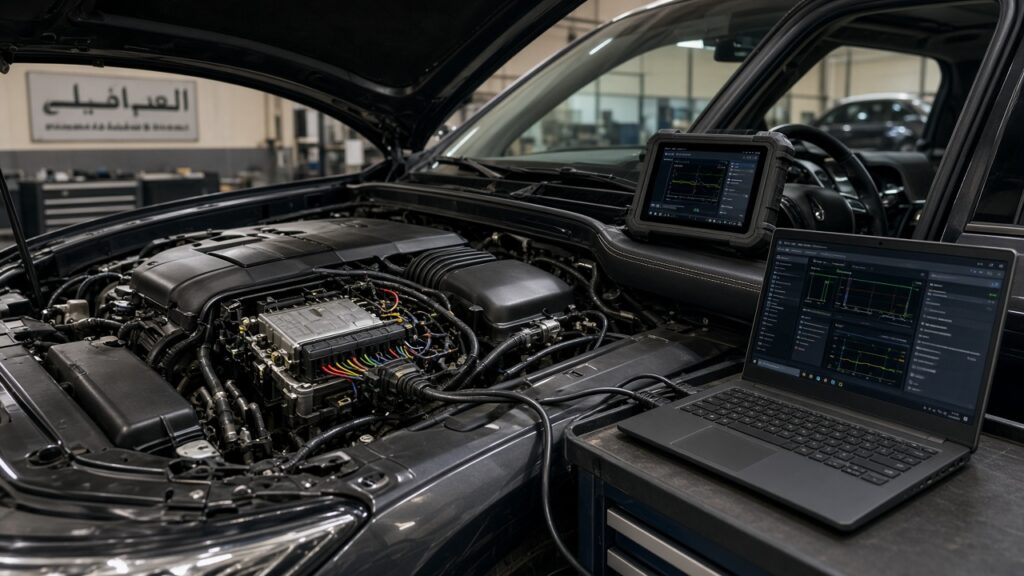
Our first step is always digital. By connecting factory-grade diagnostic scanners, our specialized technicians pull factory-level error codes from the TCU. We don’t just read the codes; we analyze live operational data logs, checking parameters such as individual clutch pressures, target versus actual gear engagement positions, and temperature deltas. This lets us see exactly what the gearbox is doing at the exact moment a jerk or shudder occurs.

Physical Inspection of Fluid Health and Mechanical Clearances

Once the digital data gives us a target, we perform physical inspections. For wet systems, extracting a small sample of the transmission fluid allows us to check for a burnt odor or suspended metallic flakes. If debris is present, it tells a clear story of mechanical breakdown inside the clutch housing, giving us a roadmap for the exact mechanical repairs required.

Comprehensive Repair Pathways: Restoring Smooth Shifting to Your Volkswagen DSG

Depending on what the diagnostic data reveals, the path to restoring your vehicle’s factory-fresh drivability will follow a distinct repair pathway customized to your specific gearbox model:

Software Readaptation and Manual Calibration Sequences

In 50% to 70% of early-stage low-speed jerking cases, physical parts do not need replacing yet. Using factory diagnostic software, our technicians reset the learned tolerances of the TCU and perform a comprehensive adaptation drive. This forces the car to relearn its clutch kiss-points, completely smoothing out the shifting experience and realigning the software parameters with the current physical state of the clutches.

Specialized Mechatronic Remanufacturing and Component Overhauls

If the mechatronic unit suffers from internal pressure loss or circuit board failure, we don’t believe in forcing you to purchase an entirely new, incredibly expensive factory gearbox assembly. Our workshop features specialized repair bays where we can isolate the mechatronic unit, replace a blown hydraulic accumulator housing, swap out failed solenoids, or repair damaged circuit traces, saving you thousands while restoring full hydraulic performance.

Precision Dual-Clutch Pack Replacement and Alignment Shimming

When the friction disks are physically worn past their mechanical adaptation limits, we install a brand-new, high-quality OEM clutch pack. This process requires extreme precision; our mechanics use specialized dual-clutch alignment jigs and micrometer gauges to shim the new clutch assemblies to within fractions of a millimeter. This meticulous attention to detail ensures that the engagement distance matches factory specifications perfectly, eliminating any chance of post-installation shudder.

High-Performance DSG Fluid and Filter Replacements

If the issue stems from fluid degradation, a complete transmission flush, fresh high-performance fluid, and a new premium filter can completely restore hydraulic pressure stability. We utilize only manufacturer-approved, high-grade DSG fluids designed to withstand the extreme thermal loads generated by local driving conditions, keeping your internal clutches cool and properly lubricated.

Proactive Ownership: Strategies to Prevent Future Gearbox Wear and Failure

The easiest way to avoid catastrophic repair bills is to stay ahead of transmission wear. Follow these essential ownership habits to protect your investment:

Maintaining Strict Transmission Fluid Change Intervals

For wet-clutch DSG variants, replacing the fluid and filter every 60,000 kilometers is mandatory. Do not skip this service, especially in hot, dusty climates like the UAE. Regular maintenance ensures that abrasive metallic particles are continuously filtered out, preventing them from wreaking havoc on the delicate solenoids within the mechatronic unit.

Modifying Driving Habits in Heavy Stop-and-Go Traffic

Creeping forward slowly by slightly releasing the brake pedal forces a dry-clutch DSG to continuously slip the clutch plate to manage speed, causing rapid heat buildup. Instead, wait for a small gap to open, release the brake fully to allow the clutch to lock up completely, and commit to moving forward cleanly. Additionally, avoid launching your vehicle aggressively from a complete standstill when the engine and transmission are not yet up to operating temperature.

Managing Vehicle Electrical Health to Support Transmission Controllers

The mechatronic unit draws massive electrical current to drive its internal hydraulic pumps and high-frequency solenoids. A weak, failing car battery or an unstable alternator voltage output can cause “ghost faults,” sensor communication errors, and abrupt shifting misfires. Ensuring your battery is tested annually and replaced at the first sign of degradation provides a stable foundation for your transmission’s electrical brain.

Why Smart Garage is Your Trusted Choice for Expert VW DSG Repairs

At Smart Garage, we understand that European dual-clutch systems require specialized care. We are equipped with dealer-level diagnostic computers, specific clutch alignment tools, and a team of experienced technicians who work on Volkswagen drivetrains every single day.

Instead of automatically recommending a full transmission swap at an astronomical cost, we focus on identifying the specific failure point—whether it’s an isolated solenoid, a cracked accumulator, or worn friction disks. We use premium OEM parts and follow factory-specified assembly procedures to restore your Volkswagen’s factory-fresh drivability, backed by transparent pricing and dependable customer service.

Get a Professional Diagnosis Today

Don’t let a minor transmission issue leave you stranded on the road. If you are experiencing Volkswagen DSG jerking and shuddering in your vehicle, bring it to the specialists who know European engineering inside and out.

Schedule your comprehensive DSG transmission inspection at Smart Garage today!

Frequently Asked Questions (FAQs)

Is a minor jerk normal for a Volkswagen DSG gearbox?

A very slight firmness during fast acceleration or a tiny hesitation when cold can be characteristic of a dual-clutch system’s mechanical nature. However, noticeable jolting, loud metallic clunks, aggressive shuddering, or highly inconsistent behavior is absolutely not normal and indicates a developing fault that requires professional attention.

Can I drive my car if the DSG is shuddering?

You should avoid driving a vehicle with severe transmission shuddering. Continuing to drive forces the clutches to slip excessively, creating extreme heat that can melt internal wiring, damage the mechatronic circuit board, and severely wear out the dual-mass flywheel, rapidly inflating your ultimate repair bill.

What is the difference between a dry-clutch and a wet-clutch DSG?

Dry-clutch systems (like the DQ200) do not use oil to cool the clutch plates, making them lighter and more efficient but highly sensitive to traffic heat and wear. Wet-clutch systems (like the DQ250 or DQ381) operate the clutches inside an oil bath, allowing them to handle significantly higher engine torque and run much cooler, provided the fluid is changed regularly.

How much does it cost to fix a DSG jerking issue?

The cost varies greatly depending on the underlying problem. A software readaptation or a simple fluid service is relatively inexpensive. However, if the car requires a partial mechatronic rebuild or a complete dual-clutch pack replacement, the cost increases due to the specialized components and precision labor required. Getting a comprehensive diagnostic scan is the only way to get an accurate estimate.

Can a software update fix my transmission shudder?

Yes, in many instances. Volkswagen regularly releases firmware updates that alter the TCU’s shifting logic, timing parameters, and clutch pressure maps. If your mechanical components are still healthy, an update paired with a manual clutch calibration can completely eliminate low-speed jerking.

How long does a DSG clutch pack typically last?

In ideal driving conditions, a wet DSG clutch pack can easily last over 150,000 to 200,000 kilometers. However, dry-clutch setups operating in severe stop-and-go urban environments and intense summer heat may begin showing signs of friction wear or shuddering around 80,000 to 100,000 kilometers if driving habits are not adjusted.

Why do dashboard lights flash when the transmission jerks?

When the mechatronic unit detects a critical fault—such as a major drop in hydraulic pressure, a stuck solenoid, or a clutch slipping beyond safe parameters—it triggers a protective mode. The flashing PRNDS or spanner symbol indicates that the TCU has restricted operations (often cutting off one of the shafts) to protect the mechanical gears from tearing themselves apart.
 Volkswagen DSG Jerking and Shuddering What’s Really Going On?

Volkswagen DSG Jerking and Shuddering What’s Really Going On?

Volkswagen’s Direct-Shift Gearbox (DSG) revolutionized the automotive world by combining the fuel economy of a manual transmission with the ease of an automatic. When working perfectly, it delivers lightning-fast, seamless gear changes. However, if you are driving through the stop-and-go traffic of Dubai or Sharjah and suddenly feel your car jolting, you are likely experiencing the notorious Volkswagen DSG jerking and shuddering phenomenon.

When a premium transmission starts misbehaving, it can be deeply frustrating. What starts as a minor vibration when pulling away from a stoplight can quickly escalate into harsh gear drops, scary hesitations at intersections, or the dreaded dashboard warning lights.

If your VW is no longer shifting smoothly, you are probably wondering: Is this a simple software glitch, or am I looking at a catastrophic mechanical failure? Let’s dive deep into what is actually happening inside your transmission and how we handle these issues at Smart Garage.

Decoding the Volkswagen Dual-Clutch Architecture: Why System Vulnerability Leads to Mechanical Shuddering

To truly understand why your vehicle is shaking, vibrating, or lunging forward unexpectedly, it helps to break down how the DSG functions under the hood. Unlike a traditional automatic transmission that relies on a fluid-driven torque converter to cushion and smooth out gear transitions, a DSG is essentially an automated manual transmission. It utilizes two independent, co-axial clutch packs—one handling the odd gears ($1, 3, 5, 7$) and the other managing the even gears ($2, 4, 6, R$). While your car is actively accelerating in third gear, the transmission’s computer has already pre-selected fourth gear on the secondary shaft, waiting to swap the clutches in a fraction of a second.

Because the DSG system relies on direct, mechanical friction engagement rather than a fluid cushion, any small irregularity in hydraulic line pressure, mechanical friction wear, or electronic sensor data becomes instantly noticeable to the driver. The transmission lacks a built-in way to hide its flaws; when a component struggles, you will feel it right through your seat. In the demanding climate of the UAE, where ambient temperatures climb drastically, these mechanical tolerances are pushed to their absolute limits, turning minor operational imbalances into prominent drivability issues.

Recognizing the Warning Signs: Primary Symptoms of Volkswagen DSG Jerking and Shuddering

DSG gearbox problems rarely stay small for long. Recognizing the symptoms early can mean the difference between a minor calibration service and an incredibly expensive total gearbox replacement. Drivers typically report a handful of distinct failure behaviors during their daily commutes:

  • Violent Shuddering from a Dead Stop: As you lift your foot off the brake pedal and apply the throttle, the car vibrates heavily across the front axle, mimicking a novice driver struggling to balance a manual clutch pedal.

  • Low-Speed Transmission Jerking in Heavy Traffic: Moving between first, second, and third gear in slow-moving traffic causes the vehicle to jolt, snap, or “snatch” aggressively into gear rather than rolling smoothly.

  • Delayed Drive Engagement Accompanied by a Loud “Bang”: When selecting Drive ($D$) or Reverse ($R$), there is a distinct two-to-three-second pause where nothing happens, followed by a sudden, harsh mechanical jolt as power is abruptly dumped into the drive wheels.

  • Shift Flares and Intermittent Power Loss: During acceleration, the engine RPMs may spike wildly between gear changes (flaring) as if the transmission is slipping, causing a sudden loss of forward momentum when you need it most.

  • Random Drops into Neutral or Total Limp Mode: The transmission suddenly drops out of gear entirely while driving, or restricts you to a single gear while flashing a spanner icon or the PRNDS lights on your instrument cluster.

Investigating the Root Causes: Technical Analysis of Gearbox Component Failure

When your Volkswagen begins to jerk and shudder, the root cause almost always boils down to one of three main culprits: the dual-clutch packs, the complex mechatronic unit, or the internal fluid condition.

Worn Dual-Clutch Packs and Friction Degradation

Just like a standard manual car, the friction linings on a DSG’s dual-clutch packs wear down over time. This is especially true for dry-clutch setups (commonly found in smaller engine variants like the 1.4 TSI with the DQ200 gearbox) which lack oil cooling to dissipate heat.

Constant stop-and-go driving in high ambient temperatures causes intense thermal stress. As the friction material degrades, the transmission control unit struggles to calculate the exact “bite point” (or kiss-point) of the clutches. The resulting slippage manifests as a severe shudder, primarily when accelerating from a standstill or shifting between low gears.

Faulty Mechatronic Unit and Hydraulic System Malfunctions

The mechatronic unit is the absolute command center of the transmission. It houses the Transmission Control Unit (TCU), an array of electronic sensors, and a complex hydraulic valve body utilizing solenoids to physically shift the gears and open the clutches.

If the mechatronic unit develops internal faults, the entire transmission loses its precision. Common failure points include:

  • Solenoid Valve Wear: Microscopic debris can cause the solenoids to stick, preventing fluid from flowing smoothly. This results in erratic, jerky shifting patterns.

  • Internal Pressure Loss: Cracks in the housing of the hydraulic accumulator or failed internal seals lead to a drop in system pressure. Without adequate hydraulic pressure, clutch engagement becomes slow, unpredictable, and violent.

  • Electronic Sensor Drift: If internal temperature or speed sensors begin sending inaccurate data to the TCU, the system applies protective, erratic behaviors that ruin drivability.

Fluid Contamination, Thermal Stress, and Sludge Accumulation

For wet-clutch DSG systems (such as the heavy-duty DQ250, DQ381, or DQ500 found in Golf GTIs, Rs, and Tiguans), the clutch packs operate completely submerged in specialized transmission oil. This fluid acts as both a coolant and a hydraulic medium.

Over time, minute metallic particles worn off the clutches mix into the fluid. If the oil is not replaced at strict intervals, this contaminated fluid turns into an abrasive sludge that clogs the fine passages within the mechatronic unit and coats the speed sensors. The immediate result is a severe shudder when the transmission gets hot, paired with unrefined shifting.

The Risk of Delay: How Minor Transmission Jerking Escalates into Catastrophic Damage

A slightly jerky transmission today can easily transform into an undrivable vehicle next week. Ignoring these early warning signs sets off a damaging chain reaction inside the gearbox.

The Damage Chain Reaction: Continuous clutch slippage creates excessive localized heat. This intense heat rapidly degrades the remaining transmission oil and cooks the delicate electronic circuit boards inside the mechatronic unit. Furthermore, unstable torque delivery puts extreme structural stress on the dual-mass flywheel, eventually causing severe internal mechanical damage.

If your vehicle exhibits unpredictable drive engagement, it can also become a safety hazard, potentially leaving you stranded in the middle of a busy highway or unable to accelerate when merging into fast-moving traffic.

Advanced Gearbox Diagnosis: The Smart Garage Diagnostic Routine

Fixing a Volkswagen DSG requires specialized diagnostic equipment and deep mechanical expertise. At Smart Garage, we never rely on simple guesswork or basic code-reading. A proper repair requires a meticulous, systematic approach to locate the true root cause.

Comprehensive Software Diagnostics and Live Data Log Tracking

Our first step is always digital. By connecting factory-grade diagnostic scanners, our specialized technicians pull factory-level error codes from the TCU. We don’t just read the codes; we analyze live operational data logs, checking parameters such as individual clutch pressures, target versus actual gear engagement positions, and temperature deltas. This lets us see exactly what the gearbox is doing at the exact moment a jerk or shudder occurs.

Physical Inspection of Fluid Health and Mechanical Clearances

Once the digital data gives us a target, we perform physical inspections. For wet systems, extracting a small sample of the transmission fluid allows us to check for a burnt odor or suspended metallic flakes. If debris is present, it tells a clear story of mechanical breakdown inside the clutch housing, giving us a roadmap for the exact mechanical repairs required.

Comprehensive Repair Pathways: Restoring Smooth Shifting to Your Volkswagen DSG

Depending on what the diagnostic data reveals, the path to restoring your vehicle’s factory-fresh drivability will follow a distinct repair pathway customized to your specific gearbox model:

Software Readaptation and Manual Calibration Sequences

In 50% to 70% of early-stage low-speed jerking cases, physical parts do not need replacing yet. Using factory diagnostic software, our technicians reset the learned tolerances of the TCU and perform a comprehensive adaptation drive. This forces the car to relearn its clutch kiss-points, completely smoothing out the shifting experience and realigning the software parameters with the current physical state of the clutches.

Specialized Mechatronic Remanufacturing and Component Overhauls

If the mechatronic unit suffers from internal pressure loss or circuit board failure, we don’t believe in forcing you to purchase an entirely new, incredibly expensive factory gearbox assembly. Our workshop features specialized repair bays where we can isolate the mechatronic unit, replace a blown hydraulic accumulator housing, swap out failed solenoids, or repair damaged circuit traces, saving you thousands while restoring full hydraulic performance.

Precision Dual-Clutch Pack Replacement and Alignment Shimming

When the friction disks are physically worn past their mechanical adaptation limits, we install a brand-new, high-quality OEM clutch pack. This process requires extreme precision; our mechanics use specialized dual-clutch alignment jigs and micrometer gauges to shim the new clutch assemblies to within fractions of a millimeter. This meticulous attention to detail ensures that the engagement distance matches factory specifications perfectly, eliminating any chance of post-installation shudder.

High-Performance DSG Fluid and Filter Replacements

If the issue stems from fluid degradation, a complete transmission flush, fresh high-performance fluid, and a new premium filter can completely restore hydraulic pressure stability. We utilize only manufacturer-approved, high-grade DSG fluids designed to withstand the extreme thermal loads generated by local driving conditions, keeping your internal clutches cool and properly lubricated.

Proactive Ownership: Strategies to Prevent Future Gearbox Wear and Failure

The easiest way to avoid catastrophic repair bills is to stay ahead of transmission wear. Follow these essential ownership habits to protect your investment:

Maintaining Strict Transmission Fluid Change Intervals

For wet-clutch DSG variants, replacing the fluid and filter every 60,000 kilometers is mandatory. Do not skip this service, especially in hot, dusty climates like the UAE. Regular maintenance ensures that abrasive metallic particles are continuously filtered out, preventing them from wreaking havoc on the delicate solenoids within the mechatronic unit.

Modifying Driving Habits in Heavy Stop-and-Go Traffic

Creeping forward slowly by slightly releasing the brake pedal forces a dry-clutch DSG to continuously slip the clutch plate to manage speed, causing rapid heat buildup. Instead, wait for a small gap to open, release the brake fully to allow the clutch to lock up completely, and commit to moving forward cleanly. Additionally, avoid launching your vehicle aggressively from a complete standstill when the engine and transmission are not yet up to operating temperature.

Managing Vehicle Electrical Health to Support Transmission Controllers

The mechatronic unit draws massive electrical current to drive its internal hydraulic pumps and high-frequency solenoids. A weak, failing car battery or an unstable alternator voltage output can cause “ghost faults,” sensor communication errors, and abrupt shifting misfires. Ensuring your battery is tested annually and replaced at the first sign of degradation provides a stable foundation for your transmission’s electrical brain.

Why Smart Garage is Your Trusted Choice for Expert VW DSG Repairs

At Smart Garage, we understand that European dual-clutch systems require specialized care. We are equipped with dealer-level diagnostic computers, specific clutch alignment tools, and a team of experienced technicians who work on Volkswagen drivetrains every single day.

Instead of automatically recommending a full transmission swap at an astronomical cost, we focus on identifying the specific failure point—whether it’s an isolated solenoid, a cracked accumulator, or worn friction disks. We use premium OEM parts and follow factory-specified assembly procedures to restore your Volkswagen’s factory-fresh drivability, backed by transparent pricing and dependable customer service.

Get a Professional Diagnosis Today

Don’t let a minor transmission issue leave you stranded on the road. If you are experiencing Volkswagen DSG jerking and shuddering in your vehicle, bring it to the specialists who know European engineering inside and out.

Schedule your comprehensive DSG transmission inspection at Smart Garage today!

Frequently Asked Questions (FAQs)

Is a minor jerk normal for a Volkswagen DSG gearbox?

A very slight firmness during fast acceleration or a tiny hesitation when cold can be characteristic of a dual-clutch system’s mechanical nature. However, noticeable jolting, loud metallic clunks, aggressive shuddering, or highly inconsistent behavior is absolutely not normal and indicates a developing fault that requires professional attention.

Can I drive my car if the DSG is shuddering?

You should avoid driving a vehicle with severe transmission shuddering. Continuing to drive forces the clutches to slip excessively, creating extreme heat that can melt internal wiring, damage the mechatronic circuit board, and severely wear out the dual-mass flywheel, rapidly inflating your ultimate repair bill.

What is the difference between a dry-clutch and a wet-clutch DSG?

Dry-clutch systems (like the DQ200) do not use oil to cool the clutch plates, making them lighter and more efficient but highly sensitive to traffic heat and wear. Wet-clutch systems (like the DQ250 or DQ381) operate the clutches inside an oil bath, allowing them to handle significantly higher engine torque and run much cooler, provided the fluid is changed regularly.

How much does it cost to fix a DSG jerking issue?

The cost varies greatly depending on the underlying problem. A software readaptation or a simple fluid service is relatively inexpensive. However, if the car requires a partial mechatronic rebuild or a complete dual-clutch pack replacement, the cost increases due to the specialized components and precision labor required. Getting a comprehensive diagnostic scan is the only way to get an accurate estimate.

Can a software update fix my transmission shudder?

Yes, in many instances. Volkswagen regularly releases firmware updates that alter the TCU’s shifting logic, timing parameters, and clutch pressure maps. If your mechanical components are still healthy, an update paired with a manual clutch calibration can completely eliminate low-speed jerking.

How long does a DSG clutch pack typically last?

In ideal driving conditions, a wet DSG clutch pack can easily last over 150,000 to 200,000 kilometers. However, dry-clutch setups operating in severe stop-and-go urban environments and intense summer heat may begin showing signs of friction wear or shuddering around 80,000 to 100,000 kilometers if driving habits are not adjusted.

Why do dashboard lights flash when the transmission jerks?

When the mechatronic unit detects a critical fault—such as a major drop in hydraulic pressure, a stuck solenoid, or a clutch slipping beyond safe parameters—it triggers a protective mode. The flashing PRNDS or spanner symbol indicates that the TCU has restricted operations (often cutting off one of the shafts) to protect the mechanical gears from tearing themselves apart.
Leave a Reply

Your email address will not be published. Required fields are marked *

Smart Garage
Service Advisor
Online
Smart Garage
Hello! How can we help you with your car today? 👋
Just now
1