Home About Services Brands Blog Contact
January 05, 2026 • battery services

Dead Battery Again? Parasitic Drain and How We Find It

There is perhaps no sound more disheartening to a car owner than the dreaded “click-click-click” of a starter motor failing to turn over on a busy morning. You turn the key or press the start button, expecting the roar of the engine, but are met with silence. Your first instinct is likely to blame the battery itself. Maybe it’s old? Maybe you left the headlights on?

But what happens when the battery is brand new? What happens when you are absolutely certain you turned off every light, closed every door, and unplugged your phone charger? If you find yourself jump-starting your car frequently despite having a healthy battery and a functioning alternator, you are likely the victim of a “parasitic drain.”

In the automotive world, we often refer to this as a “vampire draw.” It is a silent, invisible electrical fault that slowly sucks the life out of your battery while your car is parked and you are asleep. Unlike a flat tire or a smoking radiator, a parasitic drain gives no visual warning until it is too late. Understanding what it is, why it happens, and how expert technicians track it down is the key to solving your starting problems once and for all.

Understanding the “Vampire” Under the Hood

To understand parasitic drain, you first need to understand how your car’s electrical system behaves when the engine is off. In the days of vintage automobiles, turning the key to the “Off” position effectively severed the connection between the battery and the car’s components, save for perhaps a quartz clock.

However, modern vehicles never truly “sleep.” Today’s cars are essentially rolling supercomputers. Even when your vehicle is parked in your driveway with the keys on the kitchen counter, various systems remain active. The security alarm is monitoring for intruders, the keyless entry receiver is listening for your fob signal, the radio is retaining your station presets, and the Engine Control Unit (ECU) is storing learned driving data.

This constant, low-level usage of power is normal and is called “quiescent current.” A healthy battery in a modern car can easily handle this minimal load (usually under 50 to 85 milliamps) for weeks without dying. A parasitic drain occurs when a component or system fails to shut down, or an electrical short circuit allows power to flow continuously, drawing significantly more amperage than the battery can sustain. It’s the equivalent of a dripping faucet; one drop seems insignificant, but over a week, it can drain the entire tank.

The Usual Suspects: What Causes the Drain?

Pinpointing the source of a drain can be frustrating because the list of potential culprits is extensive. When vehicle owners visit our garage, they often prioritize visible mechanical issues or schedule standard Engine & Transmission Services, assuming these are the only critical aspects of car health. However, the complex electrical architecture that runs alongside the drivetrain is just as vital and prone to failure. While we are servicing the mechanical heart of the vehicle, we often uncover electrical anomalies that, if left unchecked, would leave the customer stranded.

The most common causes of abnormal drain usually fall into three categories:

  1. “User Error” and Accessory Misuse: This is the most innocent category. It includes things like a glove box light switch that doesn’t click off when the door is closed, a trunk light that stays on, or a phone charger left plugged into an “always-on” 12V socket. While these bulbs draw a small amount of power, they are relentless. Over 24 to 48 hours, a single 5-watt bulb can deplete a battery enough to prevent the engine from cranking.

  2. Defective Modules and Relays: Modern cars rely on relays electromagnetic switches to control high-power circuits. Sometimes, the contact points inside a relay can fuse together, sticking in the “On” position even when the car commands it off. Similarly, control modules (like the body control module or door modules) may fail to enter “sleep mode.” They stay awake, frantically communicating on the vehicle’s data network (CAN bus) and keeping other modules awake in a chain reaction of power consumption.

  3. Aftermarket Installations: This is a frequent issue we see in the shop. Aftermarket remote starters, non-factory alarm systems, and high-powered stereo amplifiers are often wired directly to the battery or spliced into sensitive circuits. If these are not installed with precise isolation protocols, they can continuously draw power or prevent the car’s main computer from going to sleep.

Distinguishing Drain from a Bad Battery or Alternator

Before a mechanic begins the tedious process of hunting for a parasitic drain, they must first rule out the obvious. A dead battery does not always mean something is draining it; sometimes, the battery simply cannot hold a charge anymore, or it isn’t being replenished.

There is a distinct difference between these three scenarios:

  • A Bad Battery: Inside a lead-acid battery, internal plates can become sulfated or shorted over time. If a battery is old (typically 3–5 years), it loses its capacity. It might show 12.6 volts on a meter, but under the heavy load of a starter motor, its voltage collapses instantly.

  • A Bad Alternator: The alternator’s job is to recharge the battery while the engine runs. If the alternator has failed, the car runs entirely off the battery’s stored energy until it dies. In this case, the car will usually die while you are driving, or fail to restart immediately after a drive.

  • Parasitic Drain: This is characterized by a battery that charges fine and works perfectly if the car is driven daily. However, if the car sits for a weekend or a few days, the battery is dead. This pattern Run fine, park, dead” is the hallmark of a drain.

Professional technicians use a battery conductance tester to verify the health of the battery cells and a charging system test to rule out the alternator before ever looking for a drain.

The Professional Diagnostic Process: How We Find the Fault

Finding a parasitic drain is widely considered one of the most difficult diagnostic tasks in automotive repair. It requires patience, logic, and the right tools. Unlike a mechanical part that looks broken, electrons are invisible. Here is the rigorous process expert technicians use to track down the fault.

1. Preparation and the “Sleep” Cycle

The first step is setting up the vehicle. We open the hood and latch the latch mechanism manually so the car thinks the hood is closed (otherwise, the alarm system might prevent the car from sleeping). We do the same for doors if we need interior access. Then, we lock the vehicle and wait.

This waiting period is crucial. Modern cars have a “time-out” period ranging from 10 to 45 minutes. During this time, various computers perform system checks, upload data, and slowly power down. Testing too early will give a false reading.

2. The Amperage Draw Test

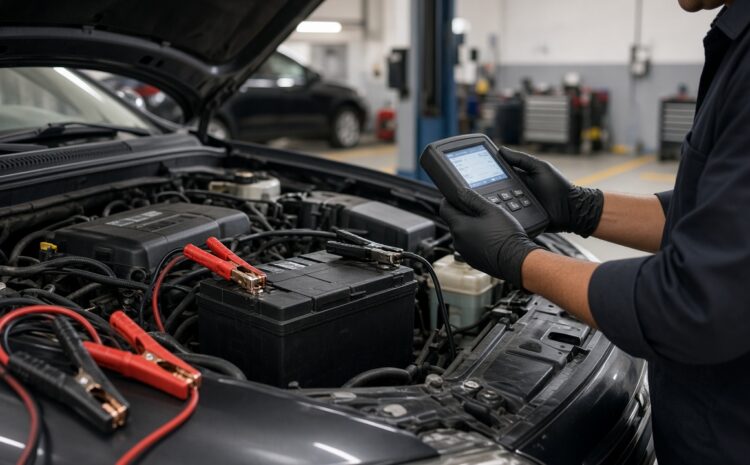
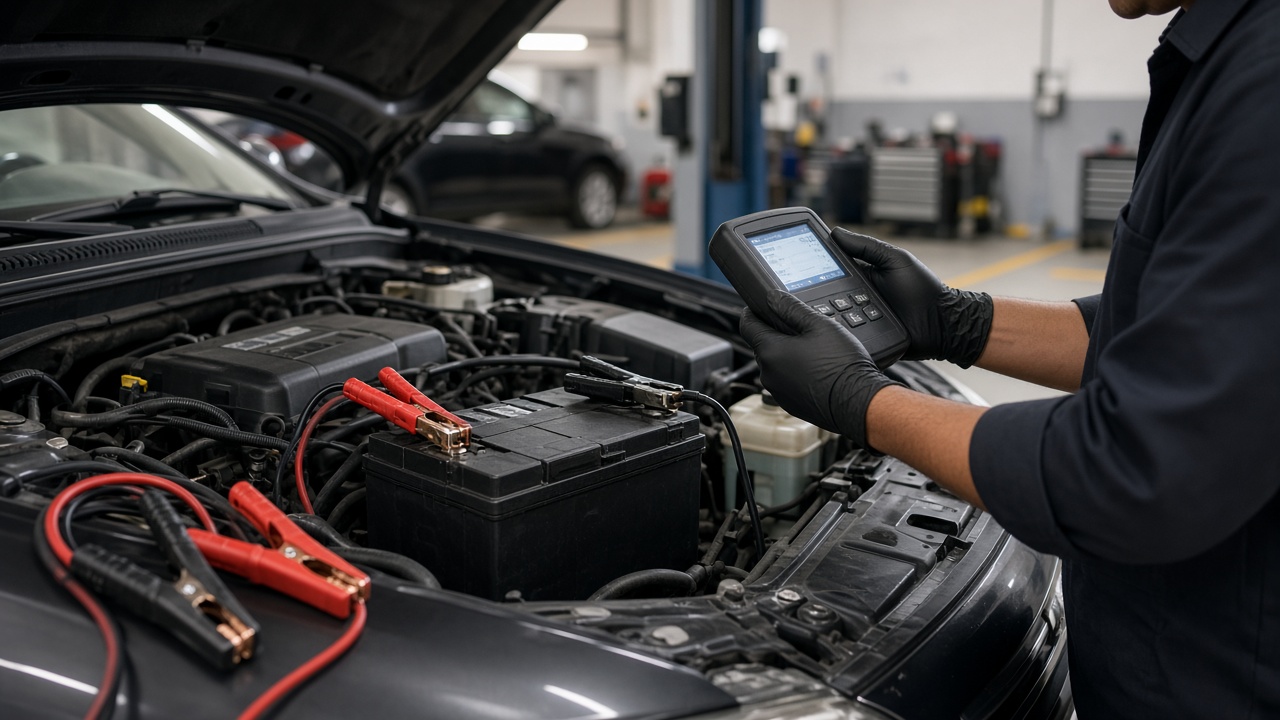
Once the car is asleep, we connect a digital multimeter or a specialized low-amp current clamp to the negative battery terminal. This allows us to measure exactly how much current is leaving the battery.

  • Normal: 20 to 50 milliamps (mA).

  • Suspicious: 50 to 80 mA.

  • Confirmed Drain: Anything over 85–100 mA. We have seen vehicles with drains as high as 3 or 4 amps, which will kill a battery in hours.

3. Voltage Drop Testing (The Modern Method)

In the past, mechanics would simply start pulling fuses one by one until the amperage reading dropped. When the reading dropped, they knew the drain was on that circuit.

However, on modern luxury and tech-heavy vehicles, pulling a fuse can “wake up” the modules. When you reinsert the fuse, the module reboots, ruining the test. Instead, we now use Voltage Drop Testing.

Every fuse has a tiny, known amount of electrical resistance. If current is flowing through a fuse, there will be a microscopic drop in voltage across it (measured in millivolts). By touching the probes of a sensitive multimeter to the top of each fuse, we can see which circuit is active without ever removing the fuse or waking up the car. If a fuse shows a 0.0 millivolt drop, that circuit is dead (good). If it shows 1.5 millivolts, we know current is flowing. We trace that specific circuit to find the component be it a stuck seat motor, a navigation unit, or a vanity mirror light that is refusing to turn off.

The Impact of Extreme Weather

It is worth noting that parasitic drains often reveal themselves during extreme weather. Batteries are chemical devices, and their performance is heavily influenced by temperature.

In the winter, a battery’s cranking power is naturally reduced by the cold oil in the engine and the slowed chemical reaction inside the battery case. If you combine a weak battery (reduced by cold) with a parasitic drain (stealing the remaining charge), the car stands no chance.

Conversely, high heat in summer increases the rate of self-discharge and corrosion. If a car has a minor parasitic drain that you haven’t noticed, a heatwave can exacerbate the issue, pushing the battery over the edge. This is why we see a spike in “dead battery” service calls during both the peaks of summer and the depths of winter. The drain was likely always there; the weather just removed the battery’s safety margin.

DIY vs. Professional Diagnosis

For the enthusiastic car owner, a basic parasitic drain test is possible with a simple multimeter. Checking for obvious things like a light that won’t turn off or an aftermarket accessory that stays lit is a great first step.

However, we strongly advise caution when dealing with the deeper electrical architecture of modern vehicles (2015 and newer). The integration of the CAN bus network means that components are no longer isolated. A drain coming from the radio fuse might not actually be the radio; it could be the instrument cluster sending a “wake-up” signal through the radio circuit.

Furthermore, improper testing methods can damage the vehicle’s ECU. Accidentally shorting a control wire while probing a fuse box can fry a computer module that costs thousands to replace. Professional garages utilize wiring diagrams and diagnostic flowcharts provided by the manufacturer to safely isolate circuits without causing collateral damage.

Prevention and Long-Term Maintenance

While you cannot prevent a relay from sticking or a module from failing, there are habits that can reduce the risk of battery drain issues.

First, be mindful of short trips. If you drive less than 15 minutes at a time, your alternator may not have enough time to replace the energy used to start the car, let alone cover any small parasitic drains. Periodically taking the car for a 40-minute highway drive ensures the battery reaches full saturation.

Second, be wary of aftermarket electronics. If you install a dashcam, ensure it is hardwired to an ignition-switched fuse, not a constant-power fuse, unless it has a voltage cutoff feature. If you use an OBDII dongle for insurance tracking or diagnostics, unplug it when the car is parked for long periods, as these devices can keep the vehicle’s network awake.

Finally, routine maintenance is key. During regular service intervals, ask your mechanic to check the battery terminals for corrosion. Corrosion adds resistance, which forces the charging system to work harder and can mask electrical issues.

Conclusion

A parasitic drain is a frustrating phantom, turning a reliable vehicle into a source of anxiety. It is not just a matter of replacing a battery; it is a matter of electrical diagnostics. By understanding that your car is a complex web of computers and circuits, you can appreciate why the “click-click” sound requires a professional eye.

If you are tired of jump-starting your car and worrying if it will start after a weekend parked, it is time to look beyond the battery. Through systematic testing and expert analysis, the “vampire” can be found, the circuit fixed, and your peace of mind restored.

 Dead Battery Again? Parasitic Drain and How We Find It

Dead Battery Again? Parasitic Drain and How We Find It

There is perhaps no sound more disheartening to a car owner than the dreaded “click-click-click” of a starter motor failing to turn over on a busy morning. You turn the key or press the start button, expecting the roar of the engine, but are met with silence. Your first instinct is likely to blame the battery itself. Maybe it’s old? Maybe you left the headlights on?

But what happens when the battery is brand new? What happens when you are absolutely certain you turned off every light, closed every door, and unplugged your phone charger? If you find yourself jump-starting your car frequently despite having a healthy battery and a functioning alternator, you are likely the victim of a “parasitic drain.”

In the automotive world, we often refer to this as a “vampire draw.” It is a silent, invisible electrical fault that slowly sucks the life out of your battery while your car is parked and you are asleep. Unlike a flat tire or a smoking radiator, a parasitic drain gives no visual warning until it is too late. Understanding what it is, why it happens, and how expert technicians track it down is the key to solving your starting problems once and for all.

Understanding the “Vampire” Under the Hood

To understand parasitic drain, you first need to understand how your car’s electrical system behaves when the engine is off. In the days of vintage automobiles, turning the key to the “Off” position effectively severed the connection between the battery and the car’s components, save for perhaps a quartz clock.

However, modern vehicles never truly “sleep.” Today’s cars are essentially rolling supercomputers. Even when your vehicle is parked in your driveway with the keys on the kitchen counter, various systems remain active. The security alarm is monitoring for intruders, the keyless entry receiver is listening for your fob signal, the radio is retaining your station presets, and the Engine Control Unit (ECU) is storing learned driving data.

This constant, low-level usage of power is normal and is called “quiescent current.” A healthy battery in a modern car can easily handle this minimal load (usually under 50 to 85 milliamps) for weeks without dying. A parasitic drain occurs when a component or system fails to shut down, or an electrical short circuit allows power to flow continuously, drawing significantly more amperage than the battery can sustain. It’s the equivalent of a dripping faucet; one drop seems insignificant, but over a week, it can drain the entire tank.

The Usual Suspects: What Causes the Drain?

Pinpointing the source of a drain can be frustrating because the list of potential culprits is extensive. When vehicle owners visit our garage, they often prioritize visible mechanical issues or schedule standard Engine & Transmission Services, assuming these are the only critical aspects of car health. However, the complex electrical architecture that runs alongside the drivetrain is just as vital and prone to failure. While we are servicing the mechanical heart of the vehicle, we often uncover electrical anomalies that, if left unchecked, would leave the customer stranded.

The most common causes of abnormal drain usually fall into three categories:

  1. “User Error” and Accessory Misuse: This is the most innocent category. It includes things like a glove box light switch that doesn’t click off when the door is closed, a trunk light that stays on, or a phone charger left plugged into an “always-on” 12V socket. While these bulbs draw a small amount of power, they are relentless. Over 24 to 48 hours, a single 5-watt bulb can deplete a battery enough to prevent the engine from cranking.

  2. Defective Modules and Relays: Modern cars rely on relays electromagnetic switches to control high-power circuits. Sometimes, the contact points inside a relay can fuse together, sticking in the “On” position even when the car commands it off. Similarly, control modules (like the body control module or door modules) may fail to enter “sleep mode.” They stay awake, frantically communicating on the vehicle’s data network (CAN bus) and keeping other modules awake in a chain reaction of power consumption.

  3. Aftermarket Installations: This is a frequent issue we see in the shop. Aftermarket remote starters, non-factory alarm systems, and high-powered stereo amplifiers are often wired directly to the battery or spliced into sensitive circuits. If these are not installed with precise isolation protocols, they can continuously draw power or prevent the car’s main computer from going to sleep.

Distinguishing Drain from a Bad Battery or Alternator

Before a mechanic begins the tedious process of hunting for a parasitic drain, they must first rule out the obvious. A dead battery does not always mean something is draining it; sometimes, the battery simply cannot hold a charge anymore, or it isn’t being replenished.

There is a distinct difference between these three scenarios:

  • A Bad Battery: Inside a lead-acid battery, internal plates can become sulfated or shorted over time. If a battery is old (typically 3–5 years), it loses its capacity. It might show 12.6 volts on a meter, but under the heavy load of a starter motor, its voltage collapses instantly.

  • A Bad Alternator: The alternator’s job is to recharge the battery while the engine runs. If the alternator has failed, the car runs entirely off the battery’s stored energy until it dies. In this case, the car will usually die while you are driving, or fail to restart immediately after a drive.

  • Parasitic Drain: This is characterized by a battery that charges fine and works perfectly if the car is driven daily. However, if the car sits for a weekend or a few days, the battery is dead. This pattern Run fine, park, dead” is the hallmark of a drain.

Professional technicians use a battery conductance tester to verify the health of the battery cells and a charging system test to rule out the alternator before ever looking for a drain.

The Professional Diagnostic Process: How We Find the Fault

Finding a parasitic drain is widely considered one of the most difficult diagnostic tasks in automotive repair. It requires patience, logic, and the right tools. Unlike a mechanical part that looks broken, electrons are invisible. Here is the rigorous process expert technicians use to track down the fault.

1. Preparation and the “Sleep” Cycle

The first step is setting up the vehicle. We open the hood and latch the latch mechanism manually so the car thinks the hood is closed (otherwise, the alarm system might prevent the car from sleeping). We do the same for doors if we need interior access. Then, we lock the vehicle and wait.

This waiting period is crucial. Modern cars have a “time-out” period ranging from 10 to 45 minutes. During this time, various computers perform system checks, upload data, and slowly power down. Testing too early will give a false reading.

2. The Amperage Draw Test

Once the car is asleep, we connect a digital multimeter or a specialized low-amp current clamp to the negative battery terminal. This allows us to measure exactly how much current is leaving the battery.

  • Normal: 20 to 50 milliamps (mA).

  • Suspicious: 50 to 80 mA.

  • Confirmed Drain: Anything over 85–100 mA. We have seen vehicles with drains as high as 3 or 4 amps, which will kill a battery in hours.

3. Voltage Drop Testing (The Modern Method)

In the past, mechanics would simply start pulling fuses one by one until the amperage reading dropped. When the reading dropped, they knew the drain was on that circuit.

However, on modern luxury and tech-heavy vehicles, pulling a fuse can “wake up” the modules. When you reinsert the fuse, the module reboots, ruining the test. Instead, we now use Voltage Drop Testing.

Every fuse has a tiny, known amount of electrical resistance. If current is flowing through a fuse, there will be a microscopic drop in voltage across it (measured in millivolts). By touching the probes of a sensitive multimeter to the top of each fuse, we can see which circuit is active without ever removing the fuse or waking up the car. If a fuse shows a 0.0 millivolt drop, that circuit is dead (good). If it shows 1.5 millivolts, we know current is flowing. We trace that specific circuit to find the component be it a stuck seat motor, a navigation unit, or a vanity mirror light that is refusing to turn off.

The Impact of Extreme Weather

It is worth noting that parasitic drains often reveal themselves during extreme weather. Batteries are chemical devices, and their performance is heavily influenced by temperature.

In the winter, a battery’s cranking power is naturally reduced by the cold oil in the engine and the slowed chemical reaction inside the battery case. If you combine a weak battery (reduced by cold) with a parasitic drain (stealing the remaining charge), the car stands no chance.

Conversely, high heat in summer increases the rate of self-discharge and corrosion. If a car has a minor parasitic drain that you haven’t noticed, a heatwave can exacerbate the issue, pushing the battery over the edge. This is why we see a spike in “dead battery” service calls during both the peaks of summer and the depths of winter. The drain was likely always there; the weather just removed the battery’s safety margin.

DIY vs. Professional Diagnosis

For the enthusiastic car owner, a basic parasitic drain test is possible with a simple multimeter. Checking for obvious things like a light that won’t turn off or an aftermarket accessory that stays lit is a great first step.

However, we strongly advise caution when dealing with the deeper electrical architecture of modern vehicles (2015 and newer). The integration of the CAN bus network means that components are no longer isolated. A drain coming from the radio fuse might not actually be the radio; it could be the instrument cluster sending a “wake-up” signal through the radio circuit.

Furthermore, improper testing methods can damage the vehicle’s ECU. Accidentally shorting a control wire while probing a fuse box can fry a computer module that costs thousands to replace. Professional garages utilize wiring diagrams and diagnostic flowcharts provided by the manufacturer to safely isolate circuits without causing collateral damage.

Prevention and Long-Term Maintenance

While you cannot prevent a relay from sticking or a module from failing, there are habits that can reduce the risk of battery drain issues.

First, be mindful of short trips. If you drive less than 15 minutes at a time, your alternator may not have enough time to replace the energy used to start the car, let alone cover any small parasitic drains. Periodically taking the car for a 40-minute highway drive ensures the battery reaches full saturation.

Second, be wary of aftermarket electronics. If you install a dashcam, ensure it is hardwired to an ignition-switched fuse, not a constant-power fuse, unless it has a voltage cutoff feature. If you use an OBDII dongle for insurance tracking or diagnostics, unplug it when the car is parked for long periods, as these devices can keep the vehicle’s network awake.

Finally, routine maintenance is key. During regular service intervals, ask your mechanic to check the battery terminals for corrosion. Corrosion adds resistance, which forces the charging system to work harder and can mask electrical issues.

Conclusion

A parasitic drain is a frustrating phantom, turning a reliable vehicle into a source of anxiety. It is not just a matter of replacing a battery; it is a matter of electrical diagnostics. By understanding that your car is a complex web of computers and circuits, you can appreciate why the “click-click” sound requires a professional eye.

If you are tired of jump-starting your car and worrying if it will start after a weekend parked, it is time to look beyond the battery. Through systematic testing and expert analysis, the “vampire” can be found, the circuit fixed, and your peace of mind restored.

Leave a Reply

Your email address will not be published. Required fields are marked *

Smart Garage
Service Advisor
Online
Smart Garage
Hello! How can we help you with your car today? 👋
Just now
1